

If you're searching for a social listening alternative, you're probably asking the right question for the wrong reason. Social listening tells you what people are saying right now across public channels—useful for monitoring trends, sentiment, and brand conversations. Audience intelligence turns those signals (and others) into decisions: which audience segments matter, what language resonates, and what direction is worth testing. In 2026, the key difference is not "data source"—it's whether the tool outputs metrics or actionable judgment.
Both categories are useful. But they solve different problems. Using the wrong one for a pre-launch decision is one of the most common (and most expensive) mistakes growth teams make. 🎯
Social Listening in 2026: What It Is (and What It Isn't)
Social listening tracks public conversations across platforms—mentions, hashtags, sentiment, share of voice, topic clusters. It answers the question: what is happening right now?
Typical inputs: social platforms, forums, news sites, review platforms
Typical outputs: volume trends, sentiment scores, competitive mention share, emerging topics
Where it shines:
- Real-time brand monitoring
- Competitive tracking and share of voice
- Trend detection and cultural moment surfacing
- Crisis response and reputation management
What it isn't: Social listening is a monitoring layer. It tells you that conversations are happening—it doesn't tell you what to do about them.
Quote-ready: Social listening is the monitoring layer. Audience intelligence is the decision layer. They're not competing—they're sequential.
Audience Intelligence: The Decision Layer for Growth Teams
Audience intelligence goes further. It takes signals (including social data, reviews, search queries, community posts, and conversations) and converts them into strategic outputs your team can act on.
Typical inputs: communities, reviews, competitor content, search queries, sales conversations, social signals
Typical outputs:
- Segment and niche maps (who, why, how urgent)
- Native language (exact phrasing your audience uses)
- Message hypotheses (claim + proof + objection)
- Direction priorities (ranked go/revise/cut)
Where it shines:
- Pre-launch research (before building assets or buying media)
- Messaging validation
- Creative direction prioritization
- Niche and segment discovery
Audience intelligence answers: who should we target, what should we say, and which direction is worth testing first?
Side-by-Side Comparison Table
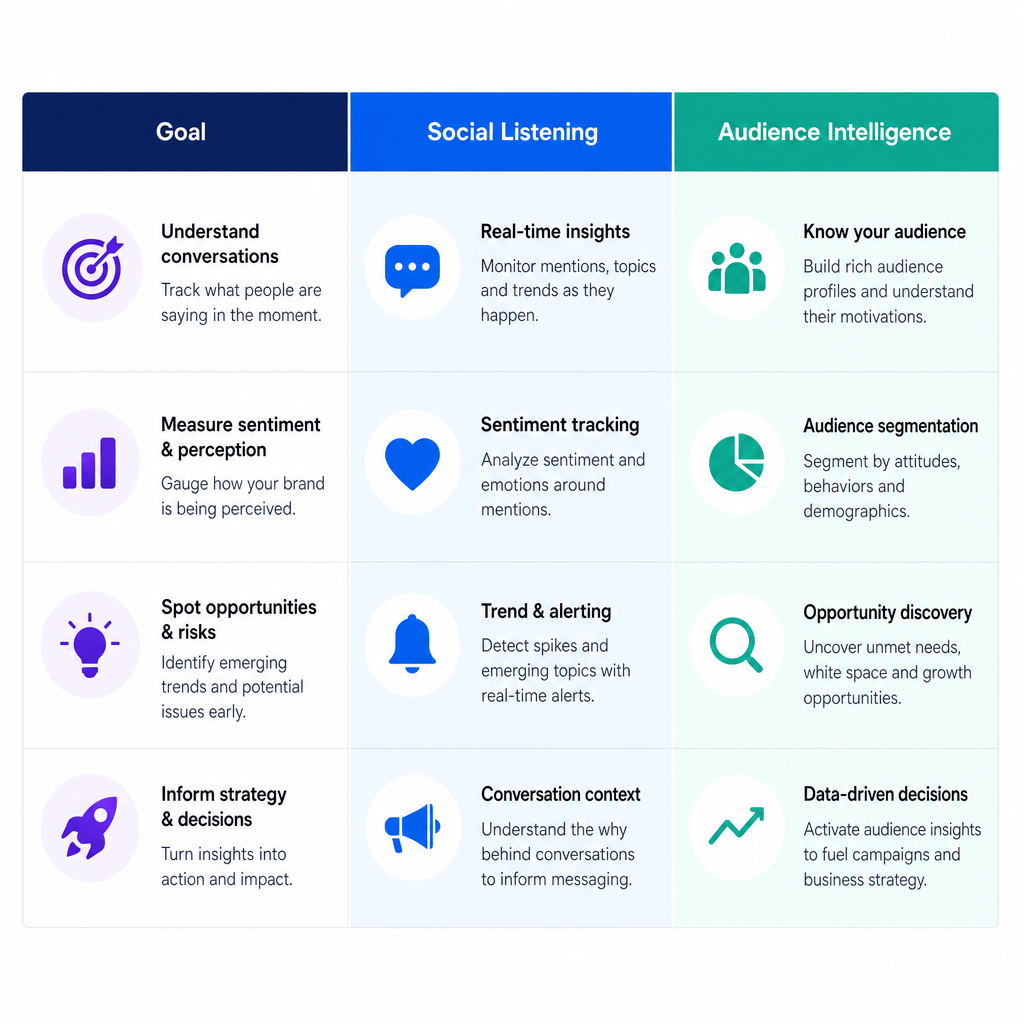
| Goal | Best tool type | What you get | Common mistake |
|---|---|---|---|
| Track brand reputation | Social listening ✅ | Sentiment, volume, mentions | Treating sentiment as strategy |
| Validate positioning before spend | Audience intelligence ✅ | Segments, language, message map | Using dashboards for strategy calls |
| Find emerging communities | Both (listening → intelligence) | Topics + segment discovery | Stopping at topic clusters |
| Decide which direction to test | Audience intelligence ✅ | Ranked go/revise/cut priorities | Gut feel over signal-based scoring |
| Monitor after launch | Social listening ✅ | Real-time trend + sentiment | Treating monitoring data as research |
One-line rule of thumb per scenario:
- Brand reputation? → Social listening.
- Pre-launch decisions? → Audience intelligence.
- Emerging community discovery? → Start with listening, finish with intelligence.
The 5 Most Common Category Mistakes
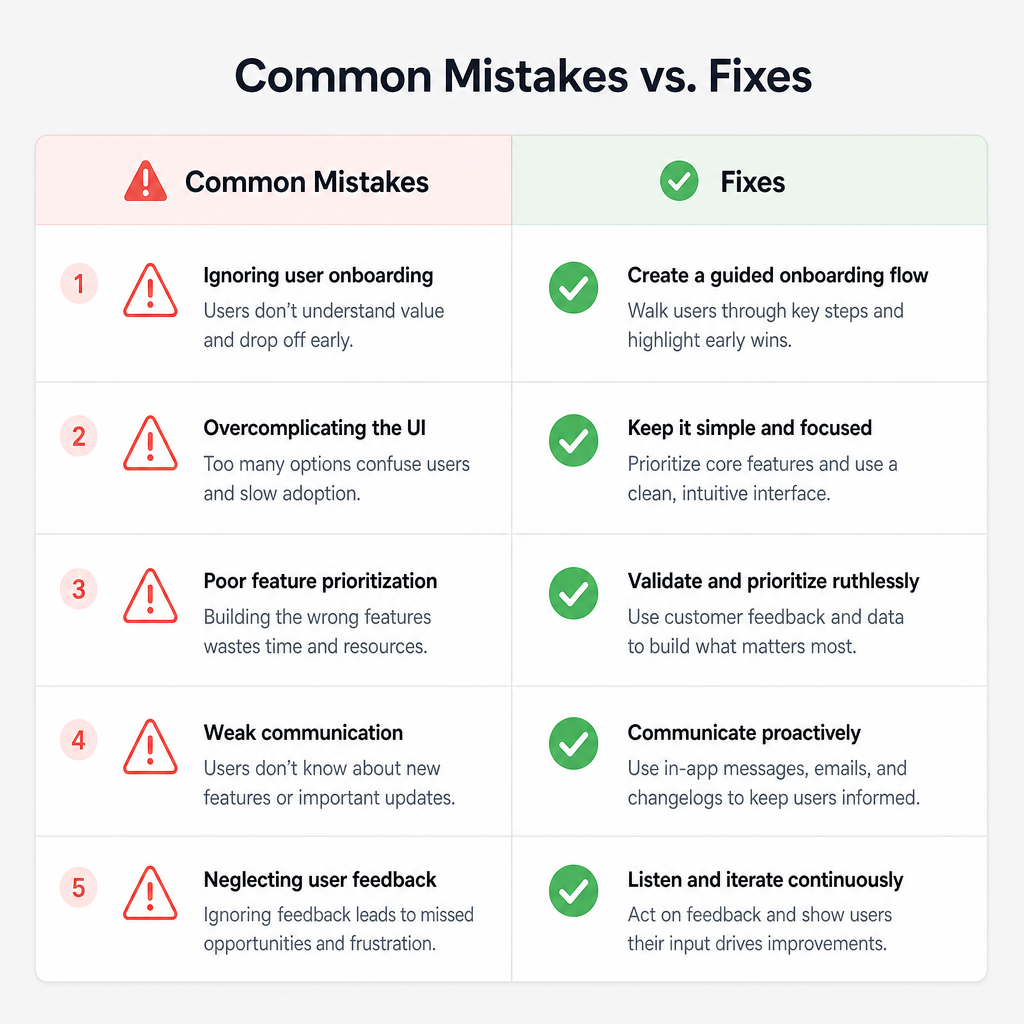
- Mistake 1 — Treating "more data" as "better insight." More signals don't improve a decision if you don't know what decision you're making. Define the question first.
- Mistake 2 — Using dashboards to answer strategy questions. A social listening dashboard can tell you sentiment is down. It can't tell you what to change in your positioning.
- Mistake 3 — Confusing demographics with segments. Age and job title aren't segments. Motivation, trigger, and constraint are. A 35-year-old CMO and a 35-year-old solo founder are completely different audiences.
- Mistake 4 — Copywriting without native language proof. Writing headlines based on what your team thinks sounds good, instead of what your audience actually says, is the most common cause of low conversion.
- Mistake 5 — Testing too many directions without a pre-screen. Running five experiments simultaneously without scoring them first means your best direction is buried in noise. Pre-screen to 2–3 before you test.
A Simple Selection Framework: Choose by Output
Step 1 — Define the decision you need to make.
Monitoring, pre-launch research, or in-flight optimization? Write it in one sentence.
Tip: If you can't write the decision in one sentence, you're not ready to pick a tool.
Step 2 — Identify the signals you can access.
Do you have public social data, community posts, reviews, or direct conversations?
Tip: Pre-launch teams often underestimate community and competitor review data. These are gold.
Step 3 — Decide whether you need monitoring or judgment.
Monitoring = social listening. Judgment (go/revise/cut) = audience intelligence.
Tip: Most pre-launch decisions require judgment, not monitoring.
Step 4 — Pick tool class + success metric.
Define what a successful output looks like before you start. Named segments? A message map? A ranked direction list?
Tip: If you can't define the output in advance, you'll end up with a dashboard instead of a decision.
Mini-scorecard — score each tool 0–2:
| Dimension | Social listening | Audience intelligence |
|---|---|---|
| Speed to useful output | 2 (real-time) | 1–2 (hours to days) |
| Depth of insight | 1 (surface signals) | 2 (motivation + language) |
| Decision support | 0–1 (metrics, not judgment) | 2 (go/revise/cut outputs) |
| Setup cost | 1–2 (moderate) | 1–2 (moderate) |
Where Klinko Fits (Without Replacing Social Listening)
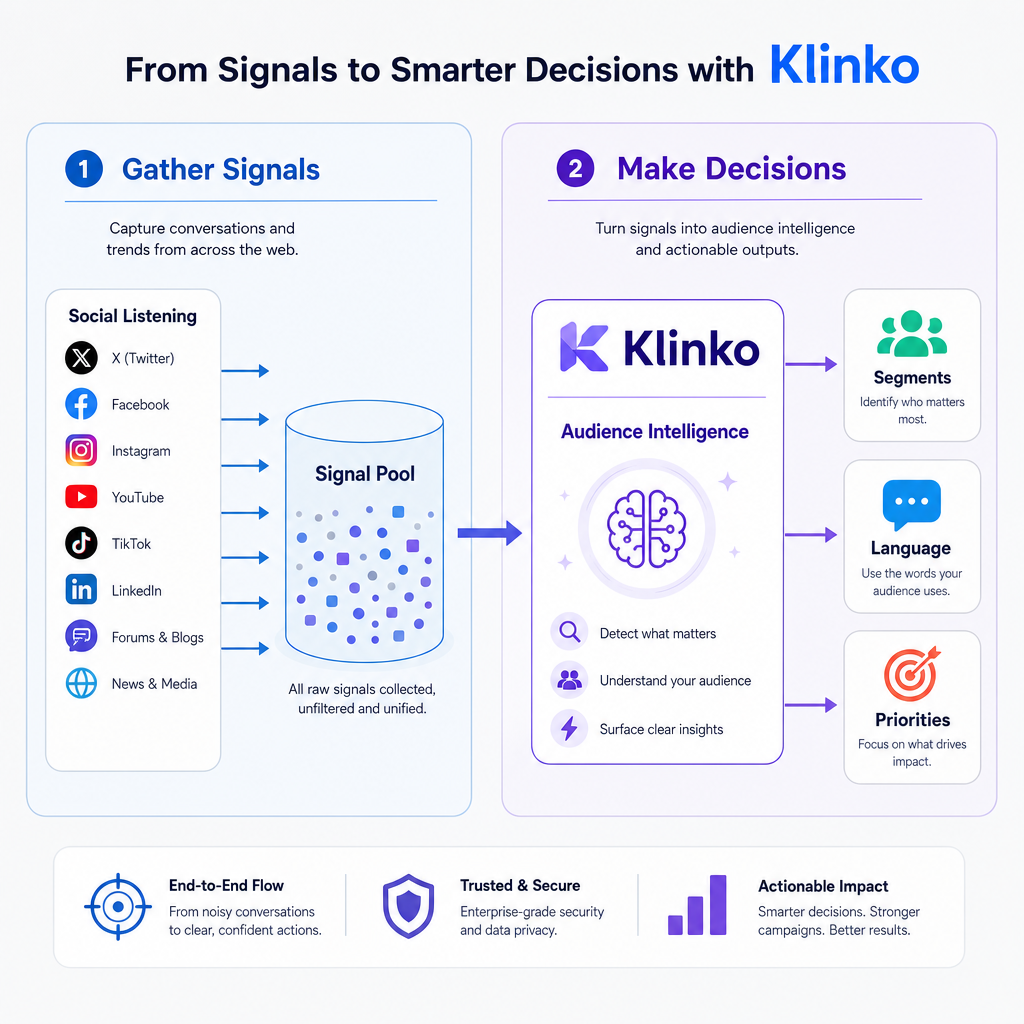
Klinko doesn't replace your social listening stack. It picks up where listening stops.
Once you have signals—from social, from communities, from reviews—Klinko helps you convert them into decisions:
- Niche/segment discovery — Find the specific clusters worth targeting
- Language extraction — Pull native phrasing and objections from raw inputs
- Message validation — Test whether your claim maps to real audience motivations
- Direction pre-screening — Rank your bets before spending on tests
After launch, keep your social listening tools for monitoring. Use Klinko for the pre-launch decision phase—when the cost of a wrong direction is highest.
FAQ
Q: Is audience intelligence just social listening with AI?
No. Social listening reports what's happening—volume, sentiment, mentions. Audience intelligence explains why it matters and what to do next. The AI isn't the difference; the output type is.
Q: When should I look for a social listening alternative?
When your core problem is pre-launch decisions—which segment to target, what message to test, which direction to pursue—not monitoring. Social listening was never designed for that job.
Q: Can I use both?
Absolutely. Use listening to gather signals at scale, then use audience intelligence to convert those signals into decisions. They're sequential, not competing.
Q: What's the fastest way to get value from audience intelligence?
Start with one decision (e.g., which segment to target) and run a small direction validation workflow with 30–50 signals. One afternoon. Clear output.
Stop Monitoring. Start Deciding.
If your team is stuck debating directions before launch, the problem isn't more data—it's the absence of a decision layer. An audience intelligence workflow like Klinko is built for that exact stage: converting signals into go/revise/cut clarity before you spend time and budget in the wrong direction. 🎯

