

learn how to pre-test creatives that get skipped less. Klinko scores your hook, CTR, and virality before any spend. Start free today.
You built the concept over three days. Brief was solid, the visuals looked good, and the product demo was clear. You launched. By day two, skip rates were above 70% and average watch time was 4.1 seconds. If you're a YouTube ad specialist, that number tells you exactly what happened — the hook didn't work. But most creative decisions still happen after launch, when the budget's already gone and data takes days to accumulate. This playbook breaks down a practical approach to pre-testing your creatives before they go live, so you can cut skip rates without running experiments on live media spend.
The core problem isn't creative quality — it's that most teams have no reliable way to evaluate a creative's hook strength, pattern interrupt effectiveness, or emotional pacing before the first dollar is spent.
Why YouTube Ads Get Skipped: A Data-Driven Analysis
Skip rates on YouTube ads aren't random. They're the result of predictable creative failures that show up in the same places across campaigns: the opening 5 seconds, flat emotional pacing, and hooks that fail to create a pattern interrupt strong enough to override the viewer's default scroll behavior.
Research across performance campaigns consistently shows that viewers decide whether to engage or skip within the first 3–5 seconds. If your creative doesn't create immediate tension, curiosity, or visual contrast in that window, skip rates trend upward regardless of how strong the offer is later in the video. A YouTube ad specialist who understands this threshold can structure creative briefs around it — before a single frame is shot. That's the difference between a $400 pre-production revision and a $4,000 post-production fix.
The 5-Second Rule: What Happens Before the Skip Button
The skip button on YouTube in-stream ads appears at the 5-second mark. But the viewer's decision to skip is typically made before that — often within 1–3 seconds based on the opening visual frame, audio tone, and whether a pattern interrupt was triggered.
A pattern interrupt is any creative element that breaks the viewer's passive consumption state: an unexpected visual cut, a direct-address question, a counter-intuitive opening statement, or a strong visual hook that doesn't match typical ad aesthetics in that category. Without one, even well-produced ads blend into the background.
Here's what that means in practice: your creative team needs to evaluate the first 3 seconds of every ad with the same rigor as the full script. The opening frame should create cognitive friction — something that makes the viewer stop and ask "wait, what is this?"
How Emotional Arc Determines YouTube Ad Watch Time
Beyond the 5-second gate, the emotional arc of a YouTube ad is what determines watch time for 15–30 second formats. Watch time directly influences YouTube's delivery algorithm, which means a flat emotional arc doesn't just hurt viewer engagement — it reduces reach at the distribution level.
An effective emotional arc for short-form ads typically follows a tension-release-resolution pattern: establish a problem or curiosity gap early (tension), deliver a surprising or satisfying insight mid-ad (release), and close with a clear outcome or CTA (resolution). When this rhythm is flat — when the ad stays at the same emotional register throughout — viewers disengage before the message lands.
A YouTube ad specialist who can map this arc before production has a structural advantage: you can identify pacing problems at the script phase, before they become expensive post-production fixes.
The YouTube Ad Specialist's Creative Pre-testing Framework
Pre-testing isn't just about asking "is this good?" — it's about answering specific structural questions before you commit to production or media spend. Here's a three-step framework that YouTube ad specialists can apply consistently across brief types and formats.
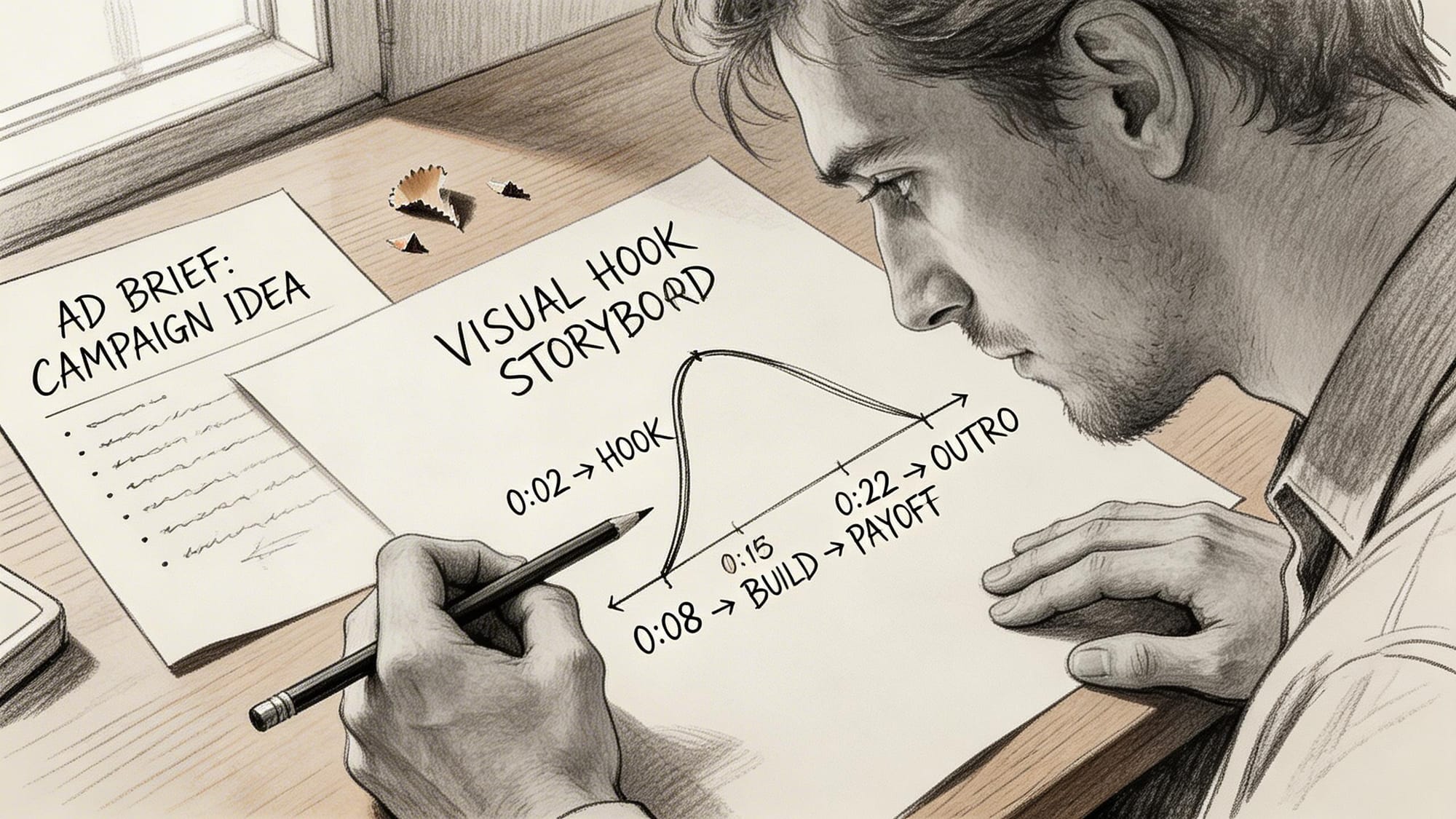
Step 1 — Score Your Visual Hook Before Production
Before any production work begins, evaluate your planned opening visual on three dimensions: novelty (does it break category convention?), clarity (does it communicate what the ad is about within 2 seconds?), and tension (does it create a reason to keep watching?). A strong visual hook doesn't need to be expensive — some of the highest-performing hooks are conceptually simple.
Examples include a counter-intuitive statement in the first frame, an extreme close-up of an unexpected subject, or an unusual visual juxtaposition that creates a question in the viewer's mind. The scoring criteria matters more than production value. If your hook scores low on tension and novelty, revising the concept now is far cheaper than re-editing after the shoot.
Run it internally with a structured rubric, or use an AI simulation tool to get audience response data before any production costs are committed.
Step 2 — Map the Emotional Arc of Your 15–30 Second Ad
For 15–30 second YouTube ad formats, plot your script against an emotional arc timeline before shooting. Mark the emotional intensity at each 5-second interval — is it building, flat, or declining? A well-structured arc should peak at approximately the 60–70% mark (around 10–18 seconds in for a 15–30 second ad), not at the end.
The most common mistake is front-loading information and back-loading emotion. Viewers don't stay for the payoff if the opening emotional register is flat. A pattern interrupt in the first 1–3 seconds, followed by a sustained tension build through the middle third, is the most reliable structure for above-average watch time.
For an experienced YouTube ad specialist, this mapping process takes under 20 minutes. Done before the shoot, it catches pacing problems that no amount of color grading or music editing can fix after the fact.
Step 3 — Cross-platform Creative Adaptation (YouTube vs TikTok)
A creative built for YouTube in-stream doesn't automatically perform well as a TikTok Spark ad. The platform contexts are meaningfully different: YouTube viewers are in a lean-back, content-consumption mindset, while TikTok audiences are in a high-velocity, swipe-first feed. The hook timing requirements differ accordingly.
For TikTok Spark ads, the pattern interrupt needs to land in the first 1–2 seconds (versus 3–5 seconds for YouTube), and the visual hook needs to match native TikTok aesthetic conventions — more casual, less produced. The emotional arc is also compressed: a 9–15 second TikTok variant typically follows a two-beat structure (hook + resolution) rather than the three-beat arc that works on YouTube.
When adapting cross-platform, treat each as a distinct creative brief, not a single edit with different aspect ratios.
Using Klinko to Pre-screen YouTube Ad Creatives
Klinko is an AI audience simulation and creative pre-screening tool built for this kind of pre-launch testing. Instead of waiting for real campaign data, you upload your creative — video, image, or copy — and Klinko runs it through a simulated audience of 100 virtual target viewers, generating a Scorecard in under 2 minutes.
The workflow is straightforward: define your target audience by platform (TikTok, YouTube Shorts, or Reels), creative goal (brand awareness, ad conversion, or follower growth), age range, and gender. Upload up to 3 assets per run. Klinko's simulation returns structured results fast, without any live media spend.
Klinko's Skip-Risk Score: What It Measures
Klinko's Scorecard includes a Hook Score that directly measures the opening creative strength — the metric most relevant to skip rate prediction. It also returns a CTR Prediction, Virality Index, and Cultural Compliance Rating, along with an audience vote breakdown across Plan A/B/C variants and verbatim audience feedback quotes.
The Hook Score maps closely to what a YouTube ad specialist would assess manually: does the opening create a sufficient pattern interrupt? Is the visual hook strong enough to override passive consumption behavior? The key advantage is that Klinko runs this against 100 simulated audience profiles matched to your target demographic, which surfaces blind spots that internal review often misses — particularly pattern interrupt effectiveness across different age segments or gender groups.
The Cultural Compliance Rating is especially useful when planning TikTok Spark ad adaptations, where creative conventions vary significantly by audience and region within North America.
Using Klinko to Test YouTube vs TikTok Creative Variants
One practical workflow: run your YouTube in-stream version and your TikTok Spark ad adaptation through Klinko as separate simulations, using the same product and target audience parameters but different platform settings. The resulting Scorecards show you where Hook Scores diverge and why — often surfacing the exact moment where the visual hook lands differently across platform contexts.
That's a data-backed basis for creative decisions before production is finalized — and considerably more efficient than running parallel live campaigns to gather equivalent signal, especially for teams managing tight creative budgets or fast-turnaround cycles.
FAQ: Why People Skip Ads and How to Fix It
Q: Why do people skip YouTube ads even when the product is good?
A: Product quality rarely drives skip behavior — hook quality does. Viewers make the skip decision before they've had time to process what's being advertised. If the opening 3–5 seconds don't create curiosity, visual contrast, or a pattern interrupt, the skip reflex activates automatically. A strong product shown through a weak hook will consistently underperform versus a modest product with a high-tension opening. The fix isn't better product messaging — it's better hook architecture: evaluating the first frame, first line of audio, and initial visual movement as independent creative assets before production begins.
Q: What makes a YouTube ad hook strong enough to avoid the skip?
A: A strong visual hook typically combines three elements: surprise (it doesn't look like a typical ad in that category), immediacy (the viewer understands something relevant within 2 seconds), and tension (it creates an open loop that demands resolution). Pattern interrupt techniques — unexpected camera angles, direct audience address, counter-intuitive opening statements — are the most reliable tactical tools. The emotional arc matters here too: an ad that opens with high emotional intensity and sustains it through the first 10 seconds tends to generate significantly higher watch time than one that builds slowly from a neutral baseline.
Q: How does Klinko help YouTube ad specialists reduce skip rates?
A: Klinko lets YouTube ad specialists run AI-powered audience simulations before a creative goes live. You upload your video, image, or copy, define your target demographic (platform, age range, gender, and creative goal), and Klinko simulates 100 virtual audience profiles, returning a Hook Score, CTR Prediction, Virality Index, and audience vote breakdown in under 2 minutes. This pre-launch data helps identify weak hooks and low-tension openings before media spend is committed. It's particularly useful for comparing a TikTok Spark ad adaptation against the original YouTube format, where hook timing and visual hook conventions differ meaningfully.
Conclusion
The work that cuts skip rates happens before the campaign launches — not after. Building a pre-testing process around hook strength, emotional arc mapping, and platform-specific visual hook evaluation gives you a structural advantage that post-launch optimization alone can't replicate. You're not waiting for the data to tell you the hook is broken. You already know.
Klinko is one practical way to run that pre-screening against simulated audience data instead of instinct. The Scorecard's Hook Score and feedback diagnostics surface the specific weaknesses most likely to drive skip behavior, so you can fix them before any budget is committed.
Haven't added a pre-launch simulation step to your workflow yet? Start with your next hero asset. Klinko's free plan gives new users 100 daily credits for the first 6 days — enough to run a real comparison across creative variants before the first dollar goes out.


