

If you're a growth team trying to make faster, smarter decisions in 2026, you've probably asked this: should we invest in audience intelligence or stick with traditional market research? The honest answer — they're not competing for the same job. Audience intelligence and traditional market research both aim to understand your customers, but they operate on completely different timescales, cost structures, and decision utilities. Knowing which tool belongs at which stage is the real skill.
Quote-ready definition: Traditional market research captures who your audience was. Audience intelligence tells you what they care about right now — and why that matters for your next move. For growth teams making fast go/no-go decisions in 2026, the two are not substitutes — they serve different phases of the decision cycle.
What Is Audience Intelligence vs Traditional Market Research in 2026?
Let's be precise about both terms before comparing them.
Traditional market research is the structured, periodic process of gathering data about a market — surveys, focus groups, panels, brand trackers. It's been the backbone of marketing strategy for decades. It's rigorous, statistically significant, and slow.
Audience intelligence is the continuous, AI-driven process of extracting signals from real audience behavior — what people post, search, share, and say about their problems and desires. It's fast, scalable, and designed for decisions, not reports.
The key distinction: static snapshot vs. continuous signal.
Traditional research tells you where the audience stood six months ago. Audience intelligence tells you where they're moving right now. For a growth team planning a campaign launch next Tuesday, that difference is everything.
The Core Differences: Speed, Cost, and Decision Utility 🔍
Breaking this down across five dimensions makes the trade-offs clear.
| Dimension | Traditional Market Research | Audience Intelligence |
|---|---|---|
| Data freshness | Quarterly / annual snapshots | Real-time or near real-time |
| Cost per insight cycle | High — surveys, panels, agencies | Low — AI-driven, scalable |
| Actionability | Descriptive — tells you what happened | Prescriptive — signals what to do next |
| Team fit | Research / insights specialists | Growth, product, marketing teams |
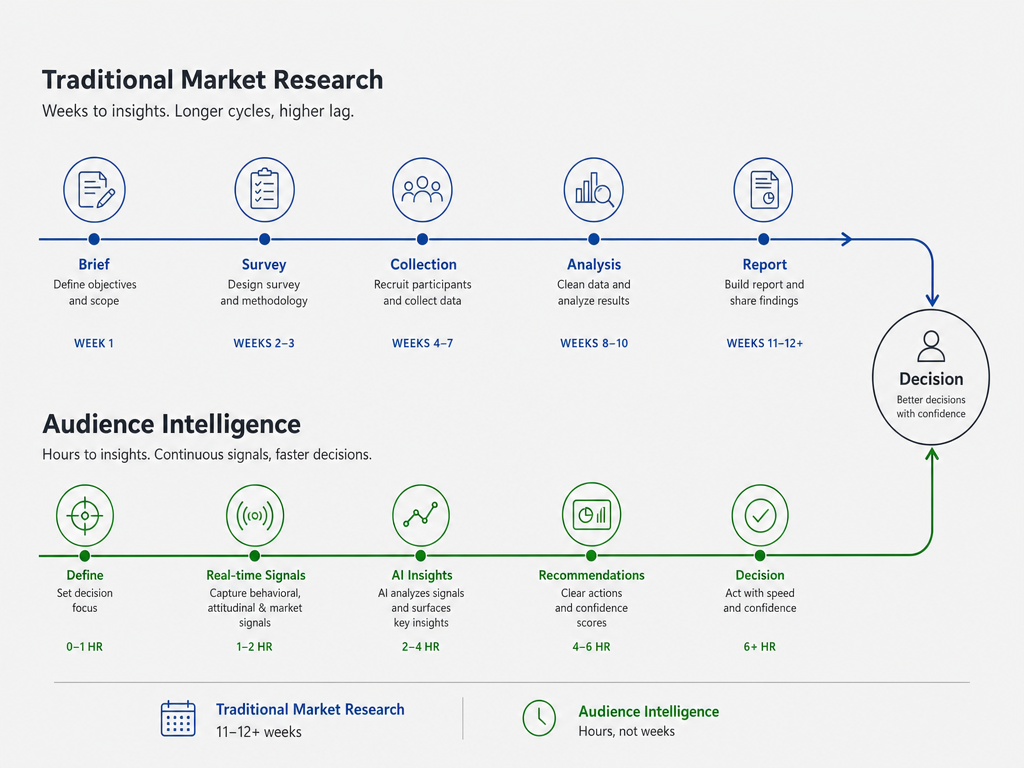
| Time-to-decision | Weeks to months | Hours to days |
| Output format | Reports and decks | Decision inputs and hooks |
The table isn't about declaring a winner. It's about matching the tool to the task.
Traditional research is built for depth and statistical confidence. Audience intelligence is built for speed and signal density. Growth teams need both — but they've historically over-indexed on the former and under-invested in the latter.
Where Traditional Research Still Wins 🏆
Here's where a lot of audience intelligence advocates get it wrong — they dismiss traditional research entirely. Don't.
There are categories where traditional market research is genuinely irreplaceable:
- Brand equity tracking: Longitudinal brand health studies require consistent methodology over time. You can't measure whether brand perception improved year-over-year with real-time signals alone.
- Statistically significant product surveys: When you need to say "87% of our target users prefer X," you need a properly sampled survey — not a social signal scrape.
- Regulatory and investor-grade data: Board decks, fundraising materials, and compliance documents require research that can be sourced, cited, and defended. AI-extracted signals don't replace that.
- Foundational market sizing: Defining total addressable market still relies on structured research methodologies.
Think of it this way: traditional research builds the map. Audience intelligence tells you where the traffic is right now.
The gap between your annual brand tracker and your next campaign launch? That's where audience intelligence earns its keep.
Case: How Trinny London Made Real-Time Audience Signals the Core of Its $93M Growth Strategy 💄
If you want a clean example of audience intelligence outperforming traditional research cycles, look at Trinny London.
What they did: Instead of relying on traditional brand research to guide expansion decisions, Trinny London built their growth engine on founder-led content and direct community feedback signals. Founder Trinny Woodall used social media as a real-time testing ground — sharing content, monitoring what resonated, and translating audience language directly into product hooks and channel strategy. Before opening their New York pop-up on Prince Street, they didn't commission a brand tracker. They ran social signal tests to validate demand and message fit in the 25–35 age group.
Measurable results (2025–2026): Trinny London achieved 25% sales growth in 2025, with revenue exceeding $93M. Retail presence doubled from 21 to 41 locations. The NYC Prince Street pop-up lifted brand awareness from 5% to 15% in their target demographic — a 3× increase without a traditional advertising-first launch playbook.
What it proves: You don't need a six-month brand study before making a major market entry decision. Real-time audience signals — engagement patterns, content resonance, community language — can substitute for, and often outperform, slow research cycles at the growth execution stage. Trinny London proved that "know who will buy and why" doesn't require an agency report. It requires reading the right signals at the right time.
For growth teams, the takeaway isn't "copy Trinny London." It's that the methodology scales. Whatever your category, the signal-to-decision loop they built is replicable — if you have the right tools to extract and interpret it.
When to Use Audience Intelligence: A Decision Framework for 2026 🎯
Here's a practical guide for matching the tool to the growth stage.
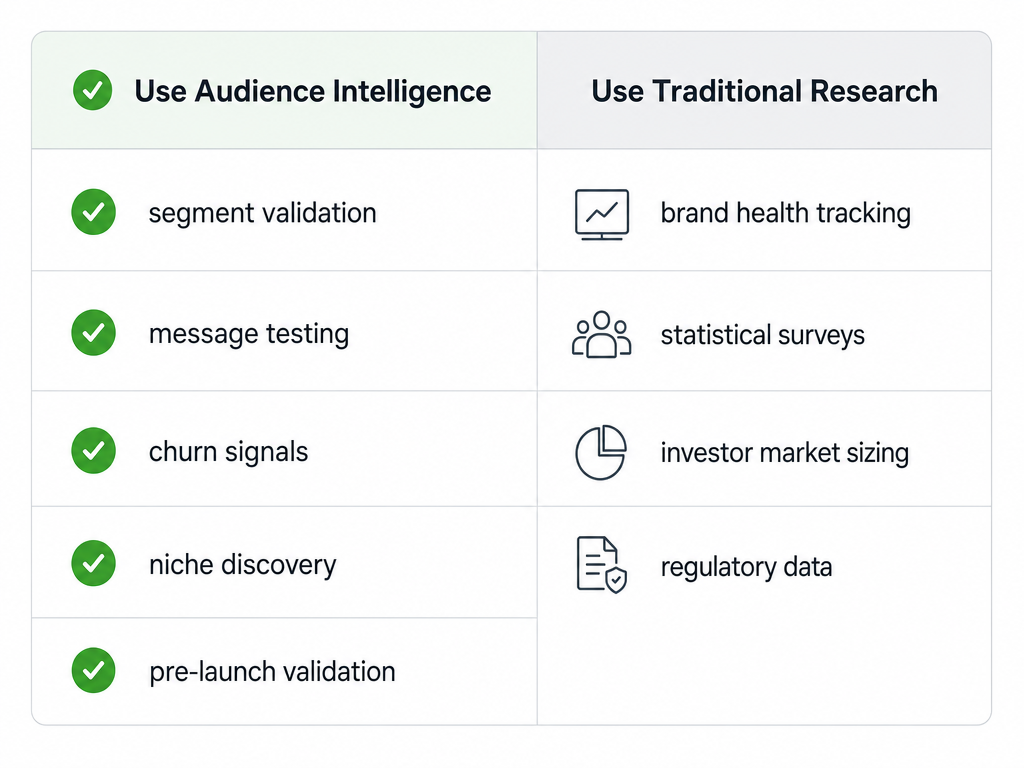
Use audience intelligence when:
- You're validating a new segment before committing budget. You need to know if this niche exists and has signal — not a survey panel opinion.
- You're testing message resonance before a campaign goes live. Audience language extraction tells you what hooks will land.
- You're investigating churn signals. What language is a disengaged cohort using? What conversations have they joined? That's audience intelligence territory.
- You're discovering emerging niches. No survey will tell you about a community that doesn't know it needs a product yet.
- You need pre-launch validation in hours, not weeks.
Use traditional research when:
- You need to measure long-term brand health with consistent methodology over years.
- You're running statistically significant product surveys that will inform major product bets.
- You're producing investor or board-grade market sizing that needs to be defensible.
- You need regulatory compliance data with documented methodology.
The mental model: Audience intelligence is your always-on radar. Traditional research is your periodic deep sonar. You need both — but for different depths.
How Tools Like Klinko Operationalize Audience Intelligence for Growth Teams ⚡
Understanding audience intelligence conceptually is one thing. Operationalizing it is another.
The reason most growth teams don't fully leverage audience intelligence isn't lack of interest — it's workflow friction. Raw social signals, forum data, and community language are noisy. Turning that noise into a structured decision input has historically required a research specialist, a data team, or both.
That's the gap tools like Klinko are built to close.
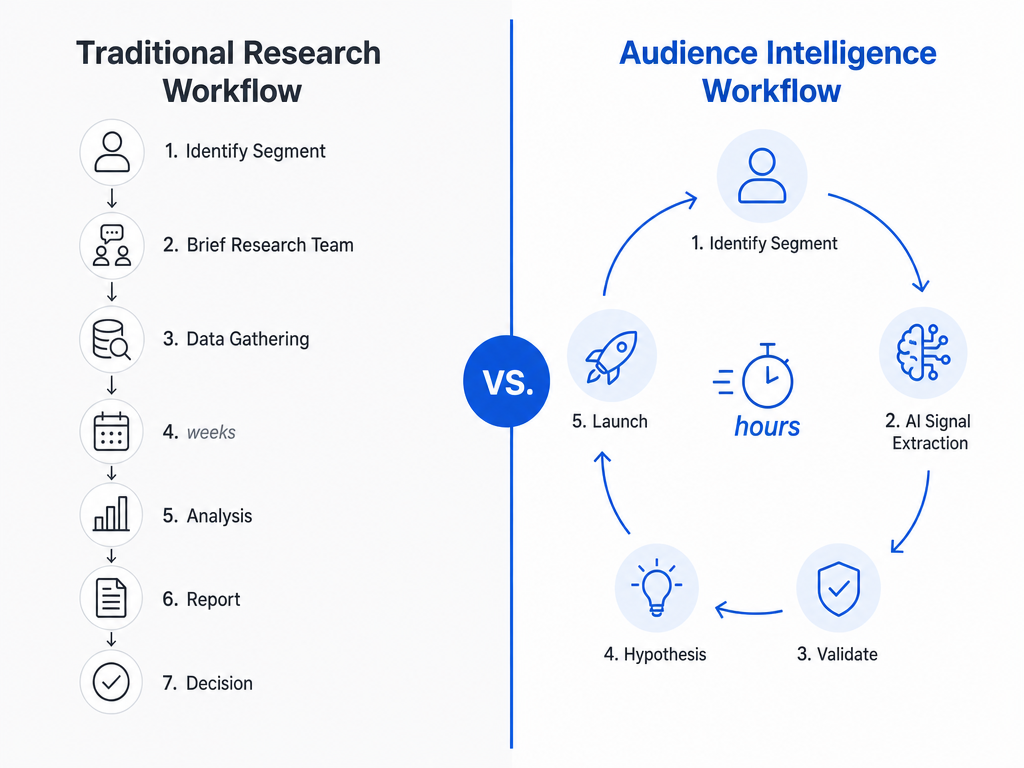
Before Klinko (or equivalent):
- Marketing team identifies a potential new segment.
- Request goes to research or data team.
- 2–4 weeks of data gathering and synthesis.
- Report lands. Campaign window has passed.
With an AI audience intelligence console:
- Growth team inputs a segment hypothesis.
- AI extracts audience language, signal density, niche clusters, and message resonance in hours.
- Team validates (or kills) the hypothesis before spending a dollar on ads.
- Campaign launches with pre-validated hooks.
The shift isn't from research to no research. It's from periodic research projects to always-on audience signal loops.
Klinko specifically focuses on niche discovery, audience language extraction, and creative pre-screening — the exact capabilities that sit between "we think this segment exists" and "we're confident enough to launch." It's not a CRM. It's not a social media scheduler. It's the decision layer before those tools come into play.
FAQ
Q: Is audience intelligence replacing traditional market research?
A: No — it's supplementing it. Audience intelligence fills the gap between slow research cycles with continuous, actionable signals. Traditional research remains essential for statistical validation, longitudinal brand tracking, and investor-grade data. The smart move is knowing when to use each.
Q: What's the difference between audience intelligence and social listening?
A: Social listening monitors brand mentions and sentiment. Audience intelligence goes deeper — it maps who your audience is, what language they use, what signals predict their decisions, and which niches are underserved. Social listening tells you what people said. Audience intelligence tells you what it means for your next move.
Q: Can small growth teams use audience intelligence tools without a dedicated research function?
A: Yes — and that's precisely the point. Modern audience intelligence platforms are built for growth and marketing teams, not research specialists. They convert raw signals into structured decisions without requiring a research background or a data team.
Q: How does audience intelligence help with go-to-market decisions in 2026?
A: It lets teams validate segment fit, test message angles, and identify high-signal niches before committing budget — reducing the cost of wrong assumptions at the launch stage. Instead of launching and learning expensively, you learn cheaply and launch confidently.
The Bottom Line: It's Not Either/Or 🚀
The decision between audience intelligence and traditional market research isn't a binary choice. It's a sequencing problem.
Traditional research gives you the foundation. Audience intelligence gives you the operating layer — the always-on signal feed that keeps your growth decisions current between those deep research cycles.
For growth teams that need faster signal-to-decision cycles without sacrificing rigor, the real question isn't "which one." It's "do we have the right tool at each stage?"
If you're missing the audience intelligence layer — the part that turns continuous signals into validated growth decisions before you spend — tools like Klinko are built specifically for that gap. Not a CRM. Not a publishing tool. A decision console for growth teams who need to know who to go after, what will resonate, and why it's worth pursuing — before the window closes.


