

An audience signal is any observable behavior — a share, a comment pattern, a purchase trigger — that reveals what a specific group genuinely cares about, before you've spent a dollar assuming it. Liquid Death didn't build a $300M brand through traditional research. They built it by reading which content went viral, why people shared it, and what emotional language was attached — then wiring those signals directly into product and campaign decisions. 🎯
This is the audience signal model. And in 2026, it's the fastest growth playbook available.
What Is an Audience Signal? (2026 Definition)
An audience signal isn't someone saying they like your brand. It's someone sharing your content without being asked, buying your product for a reason you didn't market, or using language you didn't write.
That's the signal worth building from.
Here's the key distinction most brands miss:
- High-signal behaviors: organic shares, unprompted community mentions, high engagement-to-impression ratio, unsolicited product use cases, purchase language that differs from your ad copy
- Low-signal behaviors: passive impressions, follower growth without engagement, survey-stated intent without purchase action, vanity metric spikes with no conversion trail
Surveys tell you what people say they want. Audience signals tell you what they actually do — and that gap is where most growth strategies break down.
The Liquid Death Origin Signal: Anti-Boredom, Not Anti-Alcohol
Liquid Death didn't start with a product brief. They started with a cultural observation. 🧠
Young, alternative-culture consumers found the mainstream beverage category aesthetically offensive. Not bad-tasting. Boring. The signal wasn't "people want healthier water." It was: "people who hate boring brands have no alternative in the water category."
That's a segment-signal, not a demographic. And it's a critical distinction.
A demographic says: 18–34-year-old males who buy energy drinks. A segment-signal says: people who share anti-corporate memes, buy band merch, and reach for kombucha at a bar because nothing else feels like them. The second description tells you what to build and how to speak.
Liquid Death built their entire founding identity — the skull can, the heavy metal branding, the "murder your thirst" tagline — directly from that signal.
Case Deep-Dive: How Liquid Death Turned Signals Into a $300M Brand
Let's break down the signal-to-decision chain that drove Liquid Death's growth. These aren't brand mythology — they're documented decisions with measurable outcomes.
Signal 1 → Super Bowl 2025
- What they read: Humor-forward, anti-corporate content consistently generated their highest engagement-to-impression ratios on social. Community language skewed toward self-aware absurdism — people weren't just entertained, they were performing their identity by sharing Liquid Death content.
- Decision: Leaned all the way in on absurdist, high-production humor for Super Bowl 2025 campaign.
- Result: Ad drove viral engagement and contributed to revenue exceeding $300M in 2025 — the highest category engagement-to-spend ratio for a beverage brand that year. (Source: Liquid Death brand reporting, 2025)
What it proves: When you know your audience shares content to express identity (not just because it's funny), you invest in campaigns that perform identity work — not just awareness.
Signal 2 → Sparkling Energy launch, 2026
- What they read: Community engagement patterns revealed an emerging cluster: consumers who wanted energy but were increasingly wary of extreme stimulants. The language was "I want to focus, not vibrate." Organic mentions of "natural caffeine" and "clean energy" were rising in communities that already loved the Liquid Death aesthetic.
- Decision: Launched Sparkling Energy — zero sugar, natural caffeine — in 2026, precision-targeted at that exact cluster.
- Result: Extended their TAM without diluting brand identity. Entered the energy drink market at a moment when the category's dominant players (Monster, Reign) were facing backlash over artificial stimulant content.
What it proves: Product line expansion doesn't require trend reports. It requires reading the audience you already have for signals they're sending about where they want to go next.
Signal 3 → Limited edition drops as market research
- What they did: Every limited-edition collaboration (with bands, brands, artists) functions as a real-time signal test. Which drops sell out? Which communities amplify? Which visual language gets screenshotted?
- Result: Continuous signal refinement — each drop teaches them more about the micro-communities driving their growth, without commissioning a single focus group.
What it proves: You don't need a research budget if you design your product releases as signal-collection instruments.
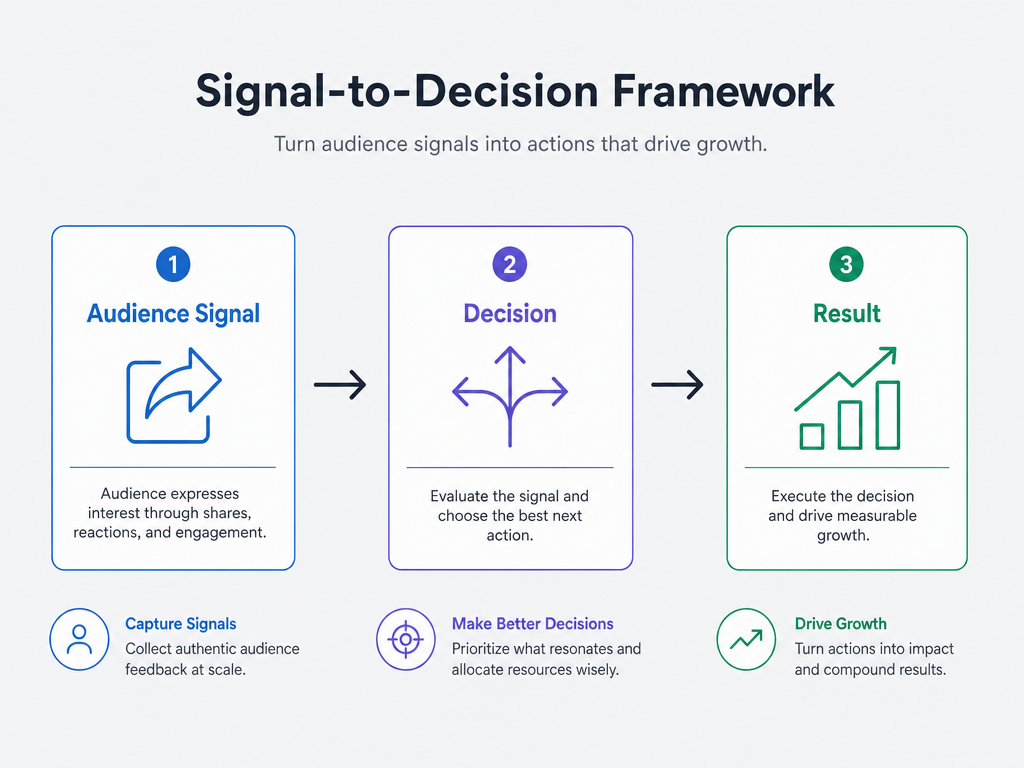
The Signal-to-Decision Framework: How to Replicate Liquid Death's Method
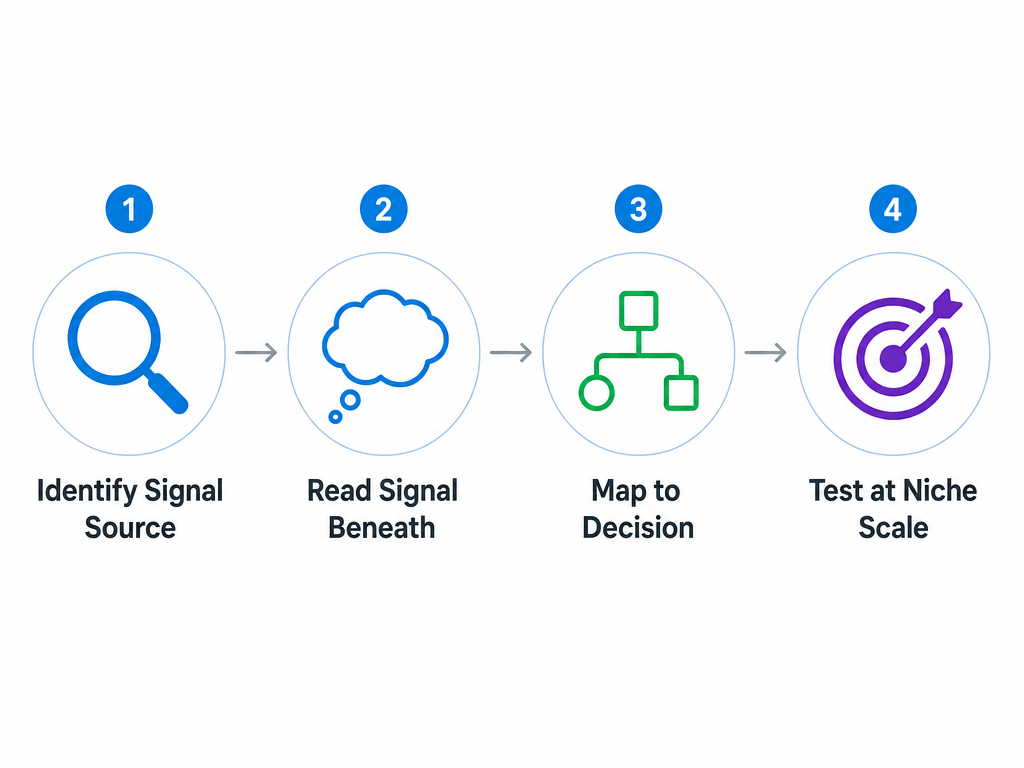
The framework isn't complicated. It's disciplined. Most brands skip Step 2 — and that's exactly where the gap opens. 🔍
Step 1: Identify your signal source
Where is your audience expressing authentic behavior? Not where you want them to be — where they actually are.
Look for: community threads, subreddits, niche newsletters, Discord servers, comment sections, product reviews, and organic share patterns — not your own analytics dashboard.
💡 Tip: Start with the communities that already buy from you, not the ones you're trying to reach. Your current customers are signaling constantly — most brands just aren't listening.
Step 2: Read the signal beneath the signal
A viral share isn't about the content. It's about what the sharer wants to say about themselves.
Ask: Why does this person share this? What does sharing it communicate about their identity, values, or peer group?
Liquid Death's most shared content wasn't just funny — it was a public declaration of anti-corporate taste. That's the signal beneath the signal.
💡 Tip: Pull the actual language your audience uses in comments and captions. That language — not your brand copy — is your highest-converting message material.
Step 3: Map signal to decision
Which product, message, or channel decision does this signal validate or challenge?
Be specific. "Our audience likes authenticity" is not a signal-to-decision map. "Our highest-shared content uses self-deprecating humor about productivity culture, which suggests a campaign angle for our new focus tool" — that's a map.
💡 Tip: Force yourself to complete this sentence: "Because our audience does X, we will do Y." If you can't complete it with specifics, you haven't extracted the signal yet.
Step 4: Test at niche scale before mass activation
Liquid Death tested viral content in small community contexts before investing in Super Bowl-scale campaigns. The limited drops are the tests.
Don't spend your full campaign budget to validate a hypothesis. Spend 10% to confirm the signal, then scale.
💡 Tip: A/B test message variants with your most engaged 1,000 followers before rolling out to cold audiences. Signal confirmation at niche scale dramatically improves conversion rates at mass scale.
Audience Signals vs. Traditional Brand Research: What Liquid Death Chose
Liquid Death didn't dismiss brand research entirely — they used it for investor-grade market sizing. But for actual growth decisions, they chose signals over surveys. Here's the structural comparison:
| Traditional Brand Research | Audience Signal Approach | |
|---|---|---|
| Data source | Surveys, focus groups, panels | Community behavior, content engagement, purchase patterns |
| Update cadence | Quarterly or annual | Continuous / real-time |
| Decision speed | Weeks to months | Hours to days |
| Cost | High (agency fees, panel costs) | Low to moderate (tooling + attention) |
| Best for | Long-term brand tracking, statistical validation | Product iteration, message testing, launch decisions |
| Liquid Death's use | Minimal — investor-grade market sizing only | Primary — drove product line and campaign choices |
The bottom line: traditional research tells you the size of the opportunity. Audience signals tell you how to win it.
What Growth Teams Can Learn From Liquid Death's Signal Stack 🚀
Here are four practitioner-level lessons — not principles, but actions.
- Track share motivation, not just share volume. Why people share your content tells you more than how many did. A post with 500 shares from identity-driven community members outperforms 5,000 passive reshares from a broad audience.
- Build your next product from your most engaged segment's language, not your average customer's demographics. Liquid Death's Sparkling Energy launch came from a specific community cluster's language — not from a market-size analysis of the energy drink category.
- Use limited editions and collabs as signal tests. Every drop is market research at the speed of culture. Design your releases to generate data, not just revenue.
- Viral ≠ reach. Viral = resonance. Optimize for content that people share to express identity, not just content that entertains. Identity-expression content builds compounding brand equity. Entertainment content doesn't.
This is where AI-driven audience intelligence tools like Klinko operationalize the Liquid Death approach at scale. What Liquid Death did manually — monitoring social engagement, tracking what content resonated in which communities, extracting the language patterns that drove sharing — Klinko automates. Growth teams can scan signals, extract audience language, and surface high-signal segments in hours, not weeks.
FAQ
Q: What is an audience signal in marketing?
An audience signal is an observable behavior — a share, a purchase pattern, a piece of community language — that reveals what a specific group of people genuinely cares about. It's distinct from stated preferences (surveys) because it's behavioral, not self-reported. High-signal behaviors include organic shares, unprompted community mentions, and language your audience uses that you didn't write.
Q: How did Liquid Death grow so fast?
Liquid Death grew by reading real-time audience signals — specifically, what content resonated with anti-establishment, health-conscious consumers — and using those signals directly to drive product and campaign decisions. Their revenue exceeded $300M by 2025, reflecting a decade of signal-first decision-making rather than traditional brand research.
Q: Can smaller brands use audience signals the same way Liquid Death did?
Yes. The method scales down significantly. You don't need Super Bowl budgets to read community signals. Start with your most engaged 1,000 followers or customers, extract the language they use, and build your next message or product variant from that. Niche-scale signal testing is actually more accessible for smaller brands than traditional research.
Q: How are AI tools changing audience signal analysis in 2026?
AI-driven audience intelligence platforms now automate what Liquid Death did manually — scanning community signals, extracting language patterns, and surfacing high-signal segments. What previously required weeks of manual social listening can now be done in hours, allowing growth teams to run multiple signal-to-decision cycles per week instead of per quarter.
The Bottom Line
Liquid Death didn't build a $300M brand by guessing what their audience wanted. They built it by reading what their audience was already doing — and making that the center of every product and campaign decision.
That's the audience signal model. And in 2026, the brands that scale fastest are the ones with the infrastructure to run it continuously.
Klinko is built to give growth teams exactly that: a real-time audience intelligence layer that turns community behavior into structured growth decisions. Signal scanning, language extraction, niche discovery, creative pre-screening — so you can move at Liquid Death speed, with the precision of a team ten times your size.
If you're ready to stop guessing and start reading, Klinko is where that starts. 🚀


