

Audience segmentation is the process of dividing your total addressable market into distinct groups based on shared characteristics, behaviors, or needs — so you can build products, messages, and channels that resonate with each group specifically. Done well, segmentation doesn't just improve targeting; it becomes the structural logic behind product decisions, pricing, and growth architecture. Lovevery's $1B milestone is a direct result of segmenting parents not by demographics, but by their child's developmental stage.
If you've ever felt like your marketing is reaching everyone but converting no one, the problem is almost always upstream: you haven't segmented clearly enough. Let's fix that.
Audience segmentation is how you stop talking to everyone and start building for someone. The segment you choose becomes the product's backbone — not just the ad's audience.
It's a strategic decision made before you write a single word of copy or choose a single channel. Segmentation tells you who exists in your market, what they need, and why they'd choose you over every alternative.
Don't confuse it with targeting. Targeting is what you do after you've segmented — it's the tactical execution. Segmentation is the map. Targeting is where you drive.
The 4 Types of Audience Segmentation (With Use Cases for Growth Teams)
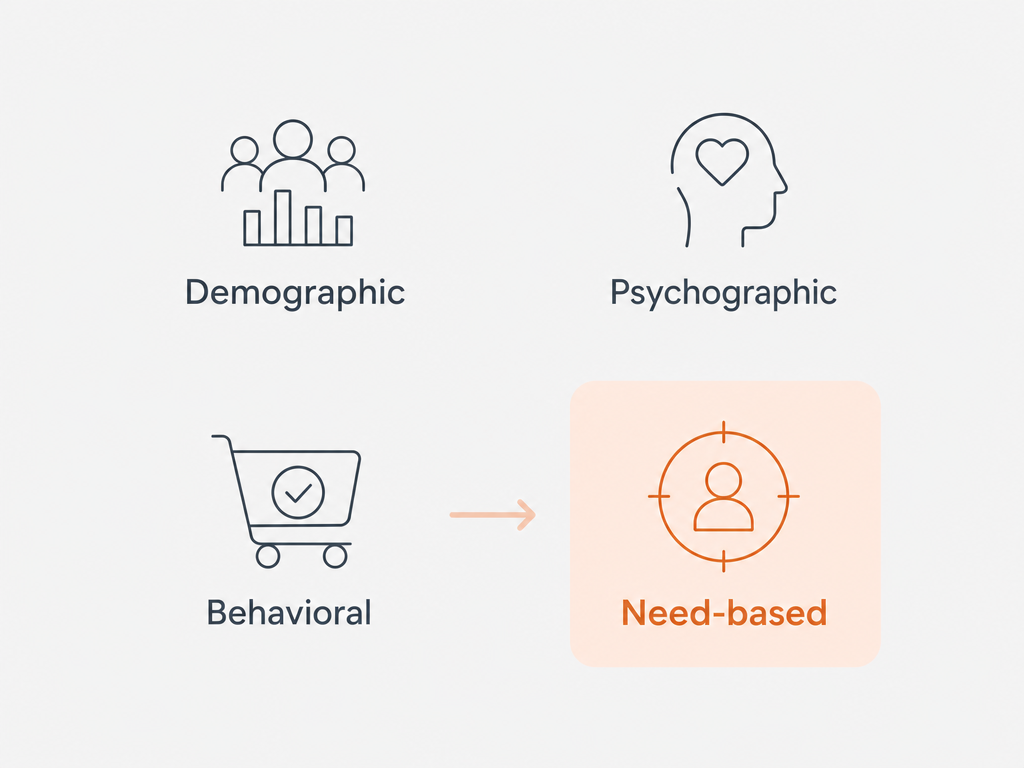
Not all segmentation is created equal. Here's a breakdown of the four main types — and why some matter more than others for growth:
- 🧩 Demographic segmentation — Age, income, location, gender. Useful for broad market sizing. Weak for product decisions. Most brands over-rely on this.
- 🧠 Psychographic segmentation — Values, attitudes, lifestyle, worldview. Great for brand voice and positioning. Harder to scale without qualitative research.
- 🔄 Behavioral segmentation — Purchase history, engagement patterns, product usage frequency. Strong for retention, upsell, and lifecycle marketing.
- 🎯 Need-based segmentation — What job is the customer hiring this product to do? This is the most predictive type for product-market fit. It's also the most underused.
Most brands over-index on demographic segmentation and under-invest in need-based. Lovevery flipped this — and it's exactly why they scaled to $1B while traditional toy brands stayed flat.
Case Study: How Lovevery Turned Developmental Stages Into a $1B Audience Segmentation Engine
Lovevery didn't segment parents by age, income, or even parenting philosophy. They segmented by the child's developmental window — 0–3 months, 3–6 months, 6–9 months, and so on through early childhood.
What they did: Each Play Kit maps to a specific developmental stage, validated through subscription usage data and in-home play tests. Every new product launch is already pre-assigned to a cohort. When Lovevery launched The Math Skill Set in May 2026, they weren't guessing which parents would buy — they already knew exactly which developmental stage cohort would need it, and why.
Measurable result: Cumulative sales exceeded $1 billion by 2025. Retail locations tripled in one year. Their 2026 expansion into academic skill sets (Math Skill Set, following the validated Reading Skill Set) came with built-in demand — because the segment was already defined and active in the subscription base. They also launched a Pre-Loved Marketplace to serve a value-conscious parent segment in later developmental stages.
What it proves: When your segmentation is precise enough, every product launch is pre-validated. You're not launching into the unknown — you're filling a slot that a clearly defined, already-engaged segment is waiting for. That's what turns a product company into a growth engine.
Lovevery's growth wasn't a result of better ads. It was a result of better segmentation architecture — built from behavioral and need-based signals, not demographic proxies.
How to Build an Audience Segmentation Strategy — Step-by-Step
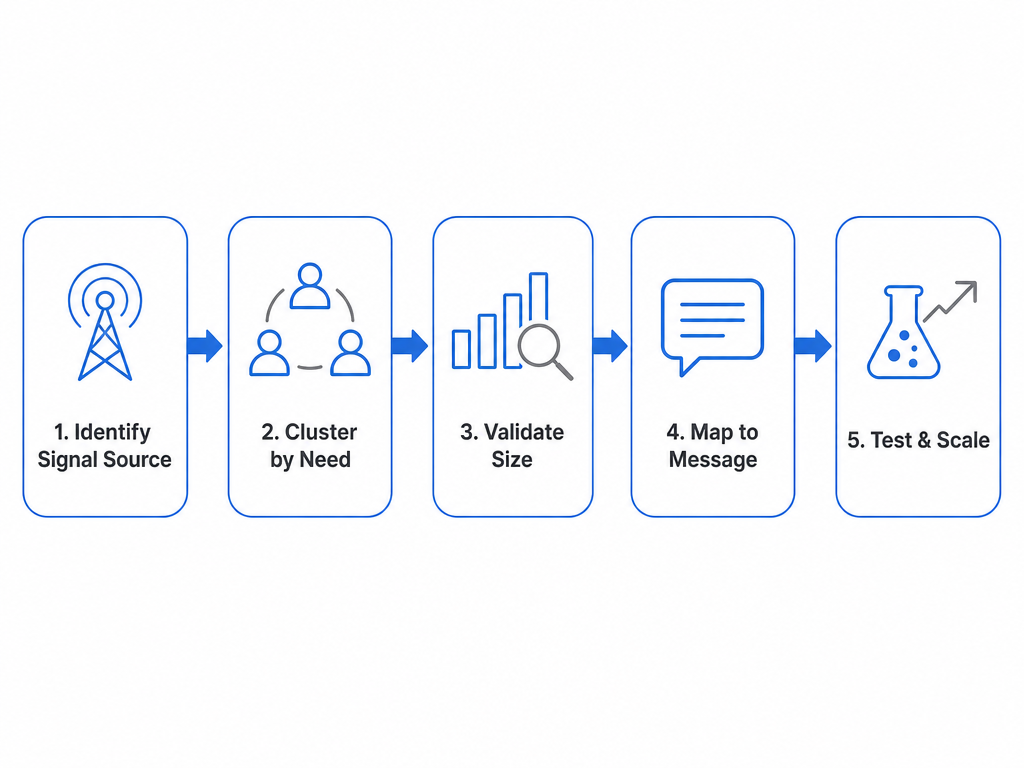
Here's a repeatable 5-step framework for building segments that actually drive decisions:
Step 1: Identify the right signal source
Start with behavioral data, community language, search intent, or subscription usage patterns. The signal source determines the quality of the segment.
💡 Tip: Don't start with a survey. Start with what people are already doing — what they share, search, and buy. Observed behavior beats stated preference every time.
Step 2: Cluster by shared need or trigger — not by demographic proxy
Ask: what's the job this audience is hiring a product to do? Group by that trigger, not by who they are on paper.
💡 Tip: Look for language patterns in community forums, reviews, and social comments. The words people use to describe their problem are often the exact hooks that convert.
Step 3: Validate segment size and willingness-to-pay
A segment isn't real until you can estimate how many people are in it and whether they'd actually spend money. Small but high-intent segments often outperform large but vague ones.
💡 Tip: Run a quick content experiment (a landing page, a social post, a single ad creative) before committing to a product or channel decision.
Step 4: Map each segment to a distinct message angle or product variant
Every real segment should produce a different message. If your messaging is identical across segments, you haven't segmented — you've just grouped.
💡 Tip: Write one-paragraph positioning statements for each segment before building campaigns. If you can't differentiate the message, merge the segments.
Step 5: Test with a small activation before scaling
Launch one piece of content, one email sequence, or one creative angle per segment. Measure engagement, not just reach. Then scale what works.
💡 Tip: Track the language that resonates, not just the conversion rate. The words that land in a small test become your full-funnel copy at scale.
Audience Segmentation vs. Audience Targeting: What's the Difference?
This is the distinction that trips up most first-time learners — and even some experienced marketers. They're related, but they're not the same thing.
| Audience Segmentation | Audience Targeting | |
|---|---|---|
| When it happens | Before product and message decisions | Before campaign execution |
| Goal | Map the full landscape of who could buy | Choose who to reach right now |
| Input | Market research, behavioral signals, language patterns | Segment definitions + budget priorities |
| Output | Segment map with distinct needs and triggers | Channel + creative brief |
| Time horizon | Strategic (quarterly or longer) | Tactical (per campaign) |
Segmentation is upstream. Targeting is downstream. If your targeting isn't working, the problem is often that the segmentation was never done properly in the first place.
How AI Tools Are Changing Audience Segment Discovery in 2026
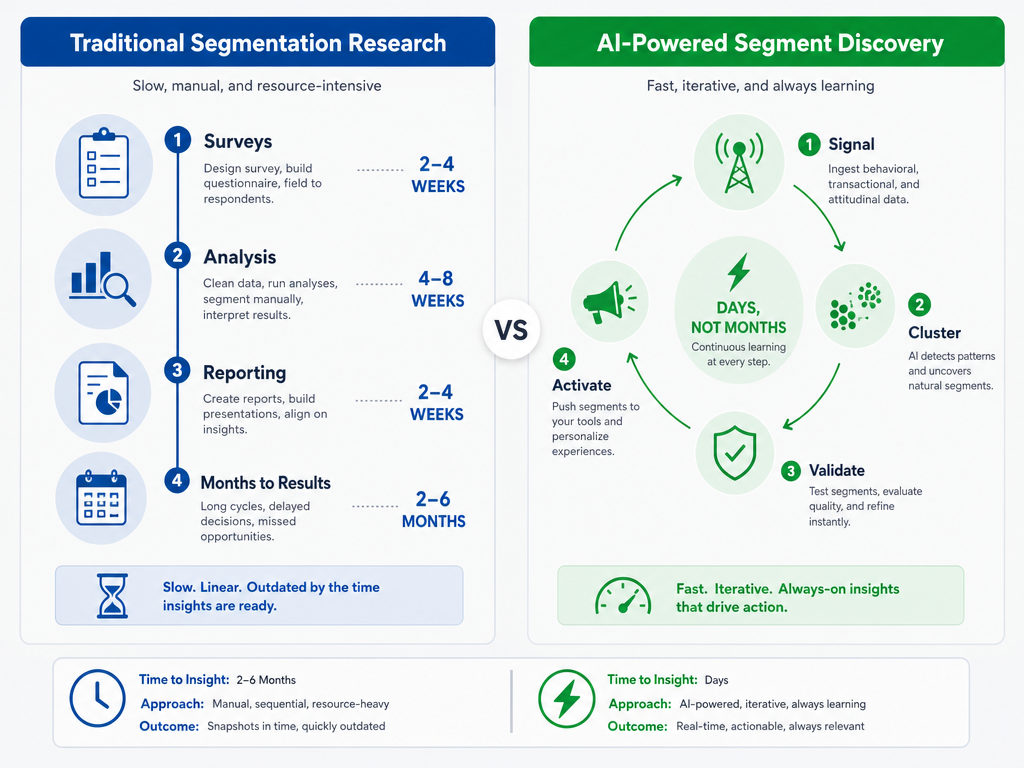
Traditionally, audience segmentation required months of qualitative research, survey design, and manual analysis. By the time you had your segment map, the market had already moved.
In 2026, AI-powered tools can automate what used to take entire research sprints:
- 🔍 Surface emerging niche clusters before they go mainstream
- 🗣️ Extract the exact language an audience uses to describe their problem
- ✅ Pre-screen creative angles against real segment signals
- ⚡ Validate segment-message fit in hours, not months
The advantage isn't knowing your segments exist — it's discovering them before your competitors do.
This is exactly the shift Lovevery made operational: using subscription usage data and in-home testing to generate real-time segment signals, then building product decisions directly from those signals. The difference now is that AI tools can compress that loop for teams without Lovevery's research infrastructure.
FAQ
Q: What is the most effective type of audience segmentation?
A: Need-based segmentation is consistently the most predictive of product-market fit. It focuses on the job the customer is hiring your product to do, rather than who they are demographically. When you segment by need or trigger, every product and message decision becomes easier to validate.
Q: How did Lovevery use audience segmentation to hit $1B in sales?
A: Lovevery segmented parents by their child's developmental stage rather than by age or income. Each Play Kit maps to a specific developmental window, making every product launch a pre-validated decision. By 2025, this approach drove cumulative sales past $1B, with retail locations tripling and a new academic skill set line expanding the segmentation model further in 2026.
Q: What's the difference between audience segmentation and customer personas?
A: Personas are narrative descriptions of typical customers. Segments are actionable clusters defined by shared needs or behaviors. Personas can be useful communication tools, but segments are what you actually build and activate against. A segment without a persona can still drive decisions. A persona without a segment is just a story.
Q: How often should you update your audience segments?
A: Review segments whenever you see meaningful shifts in engagement, conversion, or language patterns — not on a fixed calendar. In fast-moving markets, quarterly signal reviews are a reasonable baseline. If a new segment is emerging in community conversations or search trends, don't wait for the next scheduled review.
The Brands That Scale in 2026 Start With Better Segmentation 🎯
Lovevery's $1B milestone didn't come from better ads. It came from better segmentation architecture — built from real behavioral signals, not demographic assumptions.
The growth teams that win in 2026 aren't the ones with the biggest budgets. They're the ones who discovered the right segments before their competitors did — and built products, messages, and channels around precisely defined audience needs.
That's exactly what Klinko is built for. Klinko is an AI Audiences growth console that helps growth teams surface niche clusters, extract audience language, and validate segment-message fit before committing to a direction. No manual research sprints. No guesswork. Just clear signal, fast.
If you're ready to stop marketing to everyone and start building for someone, Klinko can help you find that someone — fast.

