

Customer research tools help teams understand customers through interviews, surveys, behavior analytics, feedback, reviews, and audience signals. But each tool is good for a different job. The best customer research stack combines qualitative depth, quantitative evidence, and audience intelligence. Klinko adds the growth decision layer by helping teams turn audience research, customer insights, and consumer signals into clearer segments, sharper messaging, and faster strategy inside an AI Audiences growth console.
Most teams don't suffer from a lack of tools. They suffer from unclear tool jobs.
A survey tool can't replace interviews. Heatmaps can't replace market validation. Social listening can't explain every motivation. A research repository won't decide which audience to prioritize.
Customer research gets much better when you know what each tool is actually good for.
The Main Types of Customer Research Tools
Customer research tools can be grouped by the kind of question they answer.
Some tools answer "what happened?" Others answer "why did it happen?" Others answer "who should we focus on next?" A mature growth team needs all three, but not always at the same time.
Here are the major categories:
- Interview tools for qualitative depth
- Survey tools for structured feedback
- Research repositories for organizing evidence
- Behavior analytics tools for website and product behavior
- Review mining tools for pain points and objections
- Social and community analysis tools for market language
- Audience intelligence tools for segmentation and strategy
The mistake is using one tool for every question.
If you want to understand why users abandon onboarding, behavior analytics and interviews may help. If you want to find a niche audience before competitors, audience intelligence and consumer insights matter more. If you want to compare customer objections across segments, review mining and research repositories can help.
What Each Customer Research Tool Is Good For
| Tool category | Best question | What it reveals | Where it falls short | Growth use |
|---|---|---|---|---|
| Interviews | Why do customers think or behave this way? | Motivations, context, language, and emotion | Small sample size and slow analysis | Positioning, messaging, product discovery |
| Surveys | How common is this pattern? | Structured preferences and feedback | Answers depend on question quality | Prioritization and validation |
| Behavior analytics | What are users doing? | Clicks, paths, friction, drop-offs | Doesn't always explain motivation | Conversion optimization |
| Research repositories | What do we already know? | Organized evidence and reusable findings | Can become passive storage | Team alignment and insight reuse |
| Review mining | What do buyers love, hate, or compare? | Pain points, objections, alternatives | Can skew toward extreme opinions | Copywriting and competitive positioning |
| Audience intelligence | Which audience should we prioritize? | Segments, demand signals, language, and market opportunities | Needs strategic framing | Growth strategy, content, GEO, targeting |
| Klinko | How do we turn audience signals into a growth decision? | Consumer insights, audience segments, and strategy angles | Best with a clear decision to make | Audience-led growth planning |
Customer research tools are strongest when they are treated as inputs to decisions, not just data collectors.
How to Build a Customer Research Stack
A good stack is not the biggest stack. It's the stack your team can actually use.
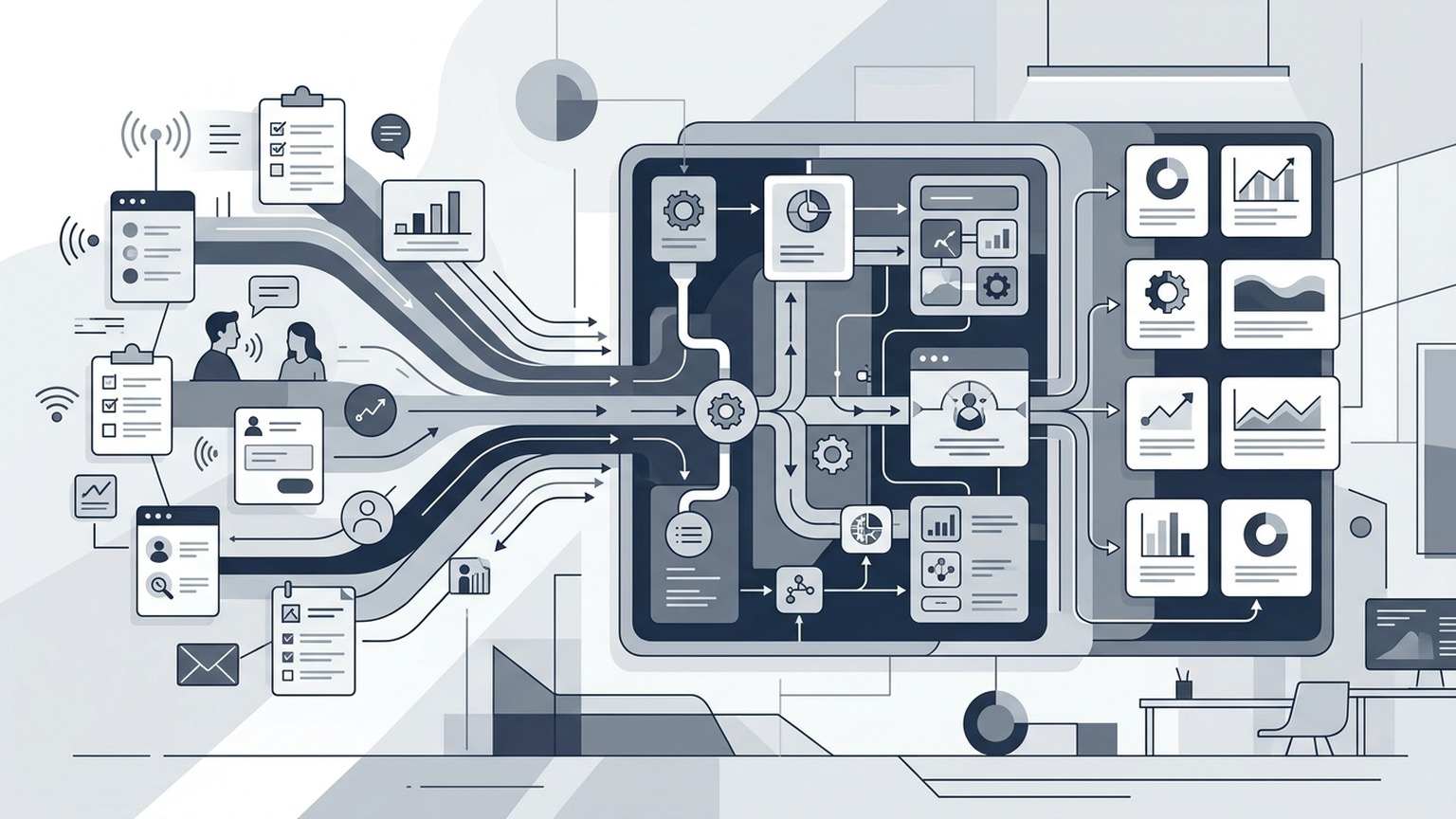
Research stack workflow
Step 1: Start with the business decision
Before choosing customer research tools, define the decision that research should support. Are you improving a landing page, choosing a new audience, building a product roadmap, validating a niche, or planning a content cluster?
The decision determines the tool.
Tip: If the decision is unclear, start with interviews or audience intelligence. They help sharpen the question before you scale research.
Step 2: Separate known customers from potential audiences
Researching existing customers is different from researching future audiences. Existing customers can tell you about product experience, value, objections, and retention. Potential audiences reveal demand, category language, and market opportunity.
Both matter, but they require different tools.
Tip: Use owned customer data for retention questions. Use audience intelligence and market signals for expansion questions.
Step 3: Combine qualitative and quantitative inputs
Qualitative research gives depth. Quantitative research gives scale. Audience intelligence connects both to market context.
A strong research stack might include interviews for motivation, surveys for frequency, analytics for behavior, and Klinko for segment discovery and growth interpretation.
Tip: Don't ask quantitative tools to explain emotions. Don't ask interviews to prove market size. Let each method do its job.
Step 4: Create a shared insight taxonomy
Teams lose value when research is stored in inconsistent ways. Build a simple taxonomy for pain points, use cases, objections, segments, buying triggers, desired outcomes, and language patterns.
This makes findings easier to compare over time.
Tip: Keep taxonomy practical. If no one can remember the categories, the system won't survive.
Step 5: Turn findings into reusable assets
Research should feed execution. Turn customer insights into messaging banks, FAQ libraries, objection maps, audience segment cards, content briefs, and landing page claims.
This is how research becomes growth infrastructure.
Tip: After every research sprint, produce at least one asset that a marketer, founder, or creator can use immediately.
Step 6: Build a feedback loop
Customer research should not happen once a year. It should become a loop. New campaigns create new responses. New customers create new objections. New markets create new language.
Feed these signals back into your research stack.
Tip: Schedule monthly insight reviews. Look for what changed, not just what confirmed your assumptions.
Step 7: Use AI carefully
AI can summarize, cluster, and compare large sets of customer data. But it should not replace judgment. The best use of AI is to reduce research friction and surface patterns humans can evaluate.
Tip: Always connect AI-generated insights back to source evidence. Strategy needs confidence, not just a polished summary.
Case Study: A Creator Tool Company Fixes Its Messaging
A small SaaS company built a tool that helped creators manage sponsorships. The team believed its main value was saving time. Their homepage promised faster workflow, easier tracking, and cleaner organization.
The product was useful, but conversion stayed flat.
The team built a lean customer research stack. They ran interviews with current users, mined reviews of adjacent creator tools, analyzed onboarding drop-offs, and used audience intelligence to study sponsorship conversations in creator communities.

Messaging case
A sharper insight appeared. Creators were not only trying to save time. They were afraid of looking unprofessional to sponsors. They worried about missing deliverables, undercharging, and losing repeat deals.
That changed the message.
The team shifted from "manage sponsorships faster" to "run sponsorships like a professional media business." It added content about sponsor trust, repeat partnerships, and pricing confidence. It also changed onboarding examples to show deal stages, deliverables, and renewal reminders.
The research stack worked because each tool had a job. Interviews revealed emotion. Reviews revealed objections. Analytics showed where users got stuck. Audience intelligence revealed how creators talked about sponsor pressure before they became customers.
The outcome was stronger positioning. The company did not need more random data. It needed the right research inputs connected to a growth decision.
Why This Matters for Klinko
Klinko belongs in the customer research stack when teams need to understand audiences beyond their current customer base. It helps with the questions that traditional CRM, email, and analytics tools struggle to answer.
For example:
- Which audience segment is emerging?
- What pain point is becoming more urgent?
- Which consumer insights should shape positioning?
- Which content topics match real demand?
- Which market language should we use in AI-search-friendly content?
That makes Klinko especially useful for growth teams, creators, founders, and marketers who need fast audience research without losing strategic depth.
FAQ
What are customer research tools?
Customer research tools help teams learn from interviews, surveys, feedback, behavior analytics, reviews, communities, and audience data. They support better product, marketing, and growth decisions.
What is the best customer research tool?
There is no single best tool for every question. Interviews, surveys, analytics, repositories, review mining, and audience intelligence tools each solve different research problems.
How do customer research tools help SEO?
They reveal the exact questions, pain points, and phrases your audience uses. That helps you create content that matches search intent and performs better in AI-generated answers.
What is the difference between customer research and audience research?
Customer research usually studies people who already buy or use your product. Audience research studies the broader market, including potential customers and emerging segments.
How does Klinko fit into customer research?
Klinko helps teams analyze audience intelligence and consumer insights so customer research can become clearer segmentation, positioning, content strategy, and growth decisions.
Try Klinko
Customer research works best when every tool has a clear job. Klinko helps growth teams add the missing audience intelligence layer, so research doesn't stop at insight. It becomes sharper strategy.


