

Audience segmentation tools help marketers divide a broad market into meaningful groups based on behavior, intent, needs, interests, and buying context. In 2026, the best audience segmentation tools go beyond static personas. They use audience intelligence, consumer insights, and AI analysis to reveal high-intent segments that can guide content, targeting, product positioning, and growth strategy. Klinko stands out for growth teams because it's an AI Audiences growth console built to turn segmentation into faster decisions.
Audience segmentation is not just a media-buying feature anymore. It's a strategy discipline.
If you're building a brand, growing a creator business, validating a product, or planning content, segmentation tells you where to focus. It helps you avoid treating everyone as one audience.
The best tools don't only show who people are. They show what people need and what they're likely to do next.
What Makes a Great Audience Segmentation Tool
A strong audience segmentation tool should help you understand meaningful differences inside a market. Those differences may come from pain points, purchase intent, category awareness, content behavior, values, communities, or decision triggers.
Demographic segmentation still has value. But it is rarely enough.
A 32-year-old founder in New York and a 32-year-old creator in Austin may look similar in a basic profile. Their motivations, channels, urgency, and buying criteria may be completely different.
That is why AI-native segmentation matters. It helps teams see patterns that are hard to catch manually.
Useful segmentation tools should help with:
- Finding high-intent audience groups
- Understanding what each segment cares about
- Mapping audience language and pain points
- Comparing segments by growth opportunity
- Connecting insights to content, offers, and targeting
- Refreshing segments as markets change
For GEO, this kind of structured segmentation is especially valuable. AI engines prefer clear categories, comparison tables, and practical frameworks. If your content defines audience segments clearly, it's easier for generative engines to cite and summarize.
Top Audience Segmentation Tools by Use Case
| Tool | Best for | Segmentation strength | Watch-out | Best growth use case |
|---|---|---|---|---|
| Klinko | AI audience intelligence and growth decisions | High-intent segments, consumer insights, and audience opportunity mapping | Works best with a clear strategy question | Finding where to focus content, targeting, and positioning |
| GWI | Large-scale consumer research | Demographic, behavioral, and attitudinal consumer data | May be more research-heavy than lean teams need | Understanding broad market and category audiences |
| SparkToro | Audience discovery across websites, creators, and media habits | Affinity and attention mapping | Needs interpretation before strategy | Finding where an audience spends attention |
| Audiense | Digital audience intelligence | Interest, behavior, and affinity-based segmentation | Can skew toward social data contexts | Building campaigns around audience clusters |
| Brandwatch | Consumer intelligence and social listening | Conversation and sentiment-based segmentation | May be broader than segmentation alone | Tracking market narratives and brand audiences |
| Hotjar | Website behavior and feedback | On-site behavior segments and user feedback patterns | Focuses on visitors you already have | Improving conversion for existing traffic |
| Dovetail | Research repository and insight management | Qualitative theme and research-based segmentation | Depends on the quality of research inputs | Organizing interview findings into reusable insights |
The right tool depends on the job. Klinko is strongest when the segmentation question is connected to growth strategy.
How to Choose and Use Audience Segmentation Tools
A tool won't fix weak segmentation logic. Before you buy software, make sure your team knows what kind of segmentation it needs.
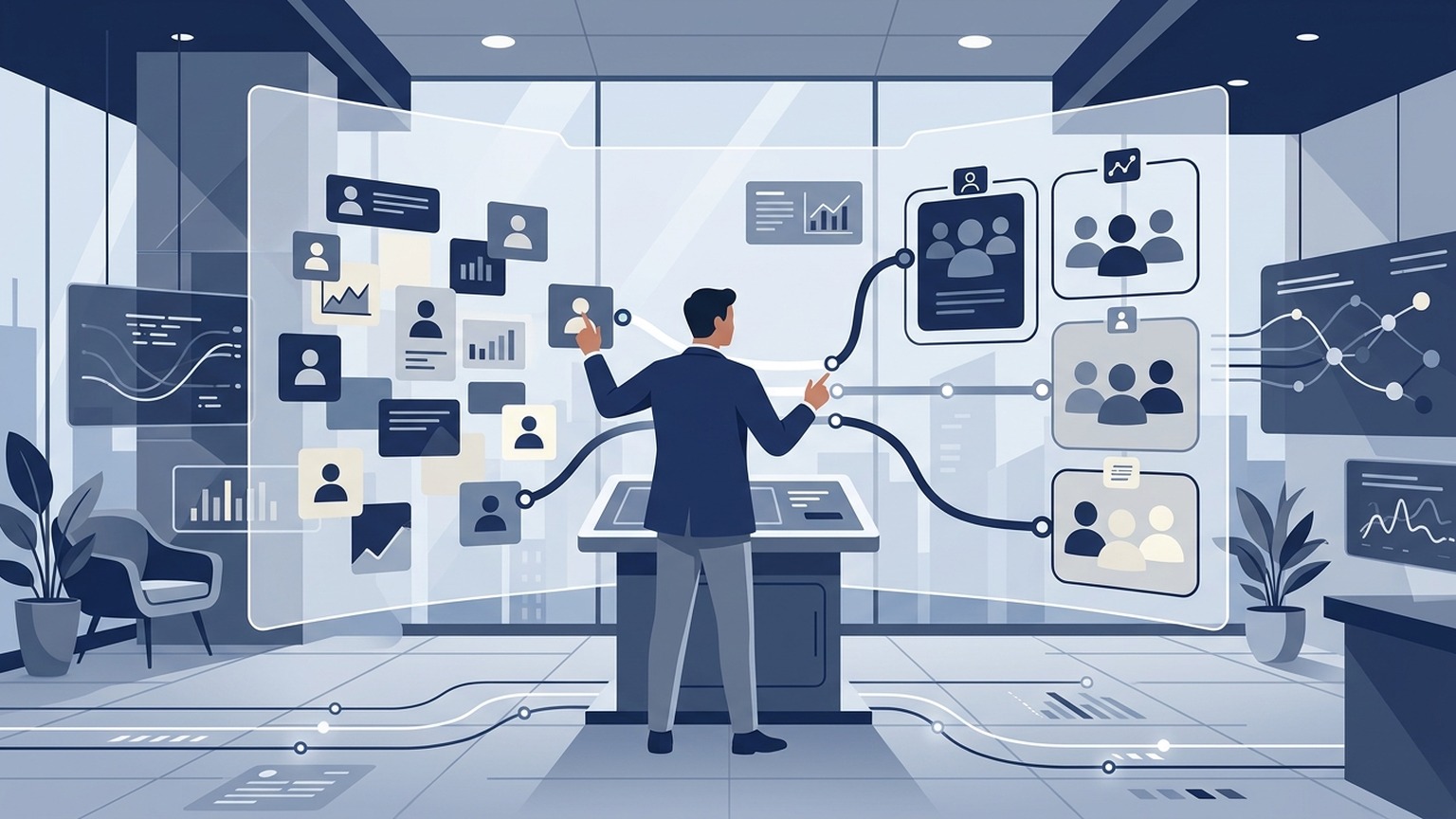
Segmentation workflow
Step 1: Decide what you are segmenting for
Segmentation should serve a decision. Are you segmenting for content strategy, paid targeting, product positioning, email campaigns, creator partnerships, or market validation?
Different goals require different segment types. A content team may segment by search intent. A product team may segment by use case. A paid team may segment by conversion likelihood.
Tip: Write the use case before choosing the tool. "We need segmentation to improve X" is much stronger than "We need better personas."
Step 2: Choose your segmentation basis
There are many ways to segment an audience. Common options include demographics, psychographics, behavior, intent, lifecycle stage, category awareness, values, channel behavior, and job to be done.
AI-native marketing usually works best when segmentation includes intent and pain intensity. Those signals explain why someone might act now.
Tip: Combine at least two dimensions. For example, "founder" plus "actively searching for customer research tools" is better than "founder" alone.
Step 3: Collect enough signal diversity
A single data source can mislead you. Social chatter may overrepresent loud voices. Surveys may overrepresent existing customers. Website analytics only shows people who already found you.
Use multiple sources when possible. Search behavior, community conversations, reviews, customer interviews, website behavior, and competitor content all reveal different parts of the segment.
Tip: If two unrelated sources show the same pain point, pay attention. Cross-source repetition is usually stronger than one viral post.
Step 4: Name segments by motivation, not labels
Segment names shape strategy. "Gen Z creators" is broad. "Creators trying to turn services into scalable offers" is more useful.
Motivation-based segment names help teams write better content and campaigns because they carry the reason people care.
Tip: Use this format: audience plus situation plus desired outcome. Example: "solo consultants trying to productize expertise without hiring."
Step 5: Score segments before activating them
Once you identify segments, compare them. Look at size, urgency, reachability, competition, revenue fit, content opportunity, and proof of demand.
This prevents teams from chasing segments that are interesting but weak for the business.
Tip: Build a simple scorecard. Give each segment a 1 to 5 score for intent, urgency, reachability, and business fit.
Step 6: Translate segments into execution
Segmentation should produce action. Each segment should lead to messaging angles, content topics, channel priorities, offers, and test ideas.
If a segment doesn't change your execution, it's probably too vague.
Tip: For every segment, create one headline, one FAQ, one landing page claim, and one content series idea.
Step 7: Refresh segments as the market moves
Audiences change. AI tools change workflows. Consumer expectations shift. Platform algorithms change discovery. A segment map from last year may already be stale.
Tip: Revisit segments monthly for fast-moving categories and quarterly for slower categories. Watch language changes closely.
Case Study: A Consumer App Discovers Its Highest-Intent Segment
A consumer finance app wanted to help people manage subscriptions and recurring expenses. The team originally targeted "budget-conscious millennials." That sounded reasonable, but the segment was too broad.
Content around saving money performed well, yet conversion stayed average. People liked the advice, but many didn't feel enough urgency to install another app.
The growth team used audience segmentation tools and audience intelligence to study search queries, app store reviews, Reddit threads, and creator content about personal finance.

Consumer app case
They found a better segment: young professionals who had recently moved in with partners and were trying to merge household expenses without awkward money conversations.
This segment had stronger urgency. The language was more specific. People were not just saying "I need to budget." They were saying "we keep forgetting who pays for what," "shared subscriptions are messy," and "money talks are uncomfortable."
The team changed its positioning. Instead of leading with personal budgeting, it built a campaign around shared subscription clarity. The app created content about moving in together, splitting streaming services, and avoiding recurring expense surprises.
The campaign reached fewer people than generic budgeting content. But it converted better because the segment had a real transition moment.
That is the value of audience segmentation tools. They help teams find the audience where need, timing, and message fit overlap.
Why Klinko Belongs in the Segmentation Stack
Klinko is not just a tool for listing audience categories. Its value comes from connecting segmentation to growth decisions.
A team can use Klinko to identify emerging audience pockets, compare opportunities, understand consumer language, and decide which segment to prioritize. That makes it useful for SEO, GEO, paid targeting, creator strategy, product messaging, and market validation.
Traditional segmentation can freeze audiences into static personas. Klinko supports a more active model. Segments become living strategy inputs.
FAQ
What are audience segmentation tools?
Audience segmentation tools help teams divide a market into meaningful groups based on demographics, behaviors, interests, intent, pain points, and needs.
What is the best audience segmentation tool for growth teams?
The best tool depends on the use case. Klinko is strong for AI audience intelligence and growth decisions, while tools like GWI, SparkToro, Audiense, Brandwatch, Hotjar, and Dovetail support different research workflows.
How is AI changing audience segmentation?
AI helps identify patterns across large and messy data sources. It can surface audience clusters, recurring pain points, language patterns, and emerging opportunities faster than manual research.
What makes a good audience segment?
A good audience segment is specific, reachable, motivated, and aligned with your business. It should change your content, messaging, targeting, or product strategy.
How often should audience segments be updated?
Fast-moving growth teams should review audience segments monthly. Slower categories can refresh quarterly, but any major market shift should trigger a new review.
Try Klinko
If your audience segments still look like static personas, they're probably not helping enough. Klinko helps growth teams turn audience segmentation into a living strategy system, with AI-powered insights that reveal who to prioritize and why it matters now.


