

Audience research before launch should end in a decision—not a report. In 2026, the fastest teams run a pre-launch workflow that identifies high-intent segments, extracts native language, validates messages, and ranks directions into go/revise/cut. This playbook shows you how to do it in days, not weeks.
Most teams skip pre-launch research or treat it as a checkbox. They build personas, run a quick survey, and call it done. Then they launch to silence—and can't figure out why. 🤔
The fix isn't more research. It's better-structured research that ends with a clear next action.
The Goal of Pre-Launch Audience Research (and the Biggest Mistake)
The goal is simple: reduce wrong bets before you build assets or buy media.
Every wrong direction you catch before launch saves weeks of wasted effort. But most teams run research as a discovery exercise, not a decision exercise.
The biggest mistake? Collecting "interesting" data without a decision output.
You know you're in this trap when your research ends with a slide deck but no one can answer: "So what do we do next?"
Quote-ready: Research should end in go/revise/cut. If it doesn't, it's not done.
Step 0: Define the Decision You Need to Make
Before collecting a single data point, write down the decision.
There are three types of pre-launch decisions:
- Segment decision — Which audience should we prioritize first?
- Message decision — Which claim and framing will resonate with our target segment?
- Direction decision — Which product angle, channel, or use case is worth testing?
Pick ONE for this sprint. Trying to answer all three at once is how you end up with 40-page reports that collect dust.
Template: "We need to decide [segment/message/direction]. We'll know we succeeded when [success metric]."
Tip: If your team debates which decision to prioritize—that IS the first decision. Resolve it before touching any data.
Step 1: Gather Raw Signals (Fast, Low-Cost)
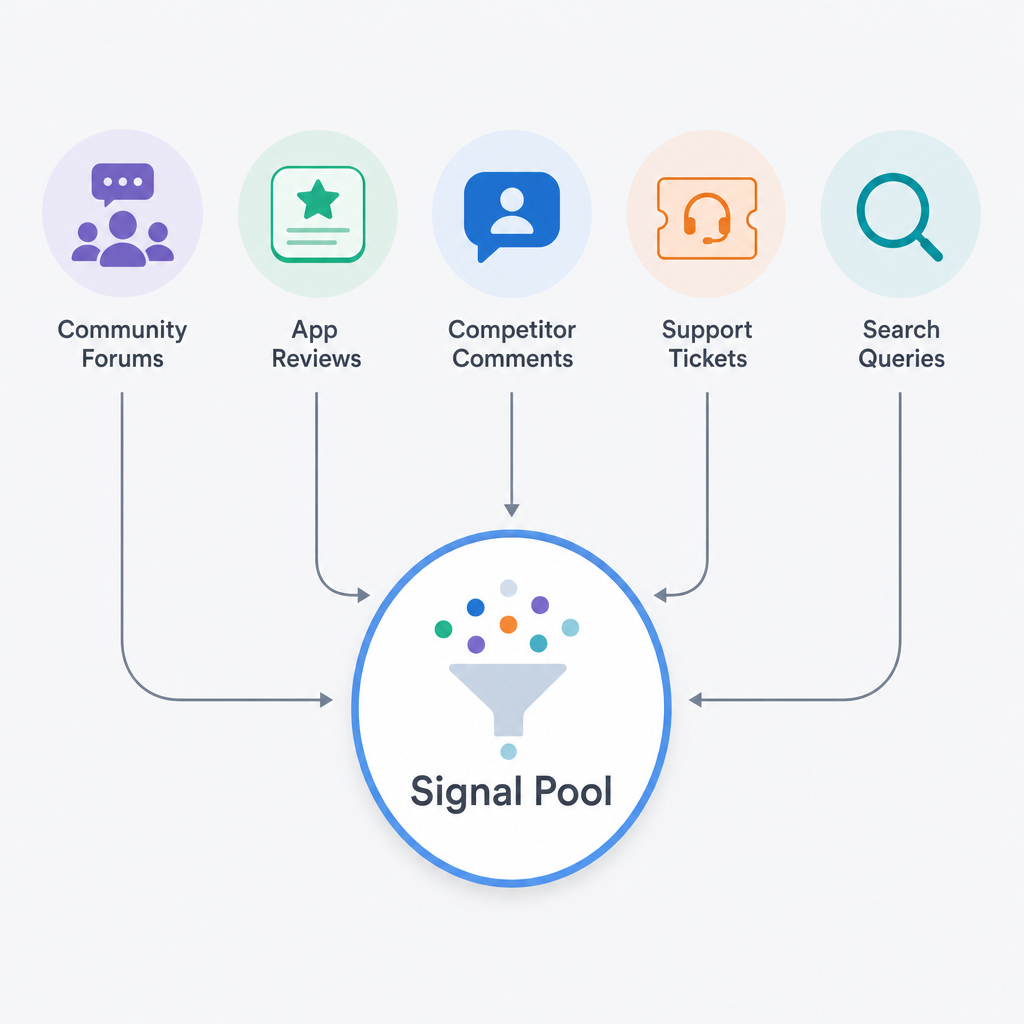
You don't need expensive panels or months of interviews. You need 30–100 raw signals from the right places.
Best sources for pre-launch signals:
- Online communities (Reddit, niche Slack groups, Discord)
- App store and G2/Capterra reviews for competitors
- Comment sections on relevant content
- Search query data (Google Search Console, keyword tools)
- Existing support tickets or sales call notes (if available)
Minimum viable dataset: 30 raw quotes. 100 is better. More than 200 without clustering first—you're wasting time.
Tip: Look for sources where people express pain unprompted. A Reddit rant is more valuable than 50 survey responses to a leading question.
Tip: Avoid sampling only from your own followers. That's confirmation bias at scale. Go where your future customers already live.
Step 2: Cluster Into Segments/Niches (Not Demographics)
This is where most teams go wrong. They cluster by age and job title. That's not a segment—it's a mailing list filter.
Real segments cluster by job-to-be-done, motivation, and constraints.
| Segment | Trigger (why now) | Desired outcome | Proof signal |
|---|---|---|---|
| Solo founders pre-launch | Product done, no users yet | First 10 paying customers | Posts asking "how do I get users?" |
| Growth leads at Series A | New role, needs quick wins | Defensible channel in 90 days | Job posts + conference talks |
| Brand marketers in planning cycle | Q3 budget opens | Justify spend with audience data | RFP requests + LinkedIn posts |
Aim for 3–7 segments. Fewer than 3 and you're not really segmenting. More than 7 and you're stalling.
Tip: For each segment, ask: "Would this person recognize themselves in this description?" If yes—it's real. If no—it's a demographic proxy.
Step 3: Extract Native Language + Objections
Native language is the single most underused output in audience research. It's also the highest-leverage one.
Native language = the exact words your audience uses to describe their pain, desired outcome, and alternatives.
What to capture:
- Pain phrases ("I spend hours every week just trying to...")
- Desired outcome language ("I just want to...")
- Alternative framings ("I tried X but it was...")
- Objection signals ("The problem with tools like this is...")
Output: A language bank with 20–50 raw quotes tagged by segment and theme. Plus a top 10 objections list.
Tip: Use this language in your landing page headline and you'll likely outperform anything you write yourself. It's not laziness—it's precision.
Step 4: Validate Messages (Before Writing Full Assets)
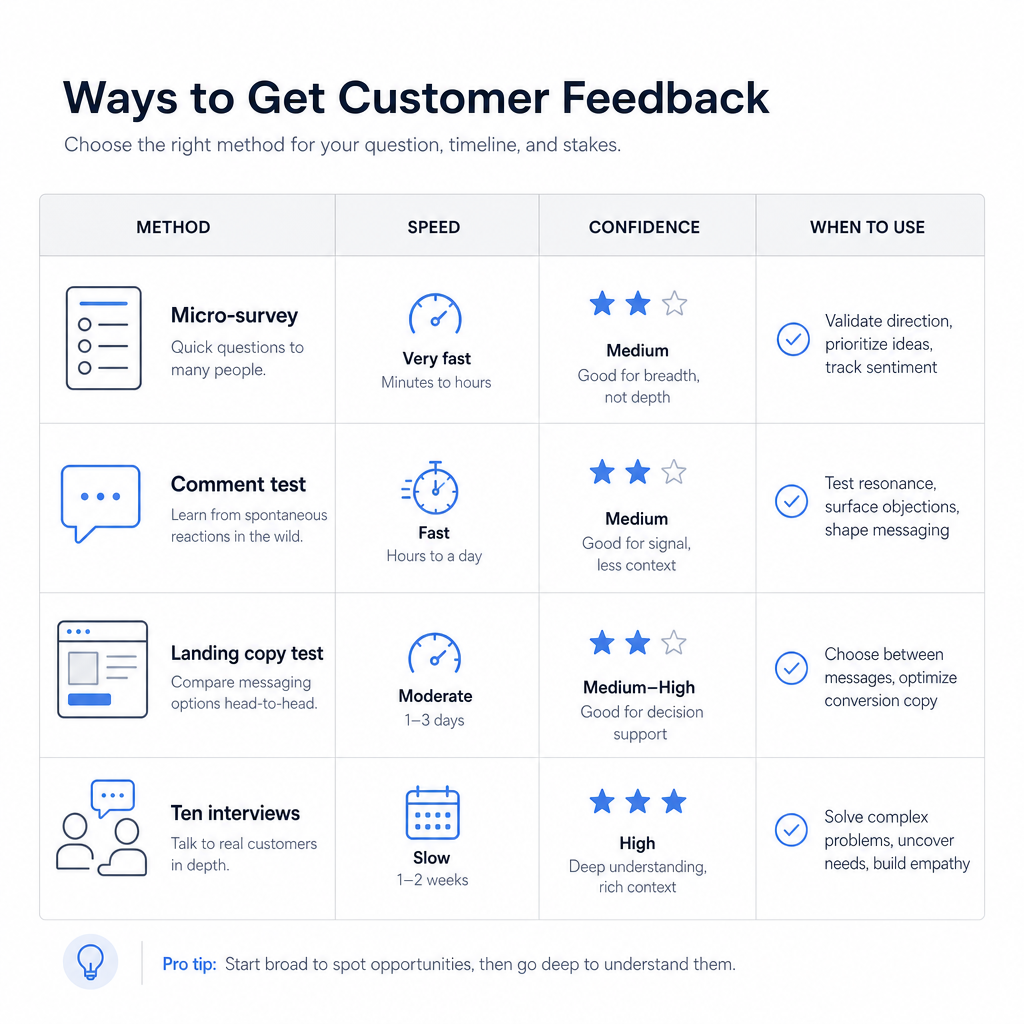
Message validation isn't asking "do you like this?" It's asking: does this claim + proof + contrast resonate with this specific segment?
Create 3 message hypotheses. Each has three parts: claim → proof → contrast (what makes it different from the alternative).
| Method | Speed | Confidence | When to use |
|---|---|---|---|
| Micro-survey (3–5 questions) | 2–3 days | Medium | Quantify a hypothesis you already have |
| Comment / community test | 1–2 days | Low–Medium | Fast directional signal |
| Landing copy A/B test | 1–2 weeks | High | When you have traffic to split |
| 10 targeted interviews | 5–7 days | High | Deep motivation + objection surfacing |
Tip: Use micro-surveys for speed, interviews for depth—then triangulate the two.
Step 5: Pre-Screen Directions (Go / Revise / Cut)
If you have 2–4 potential directions, don't test them all. Pre-screen first.
Score each direction on four dimensions (0–2 each):
- Audience fit — Does this direction map to a high-signal segment?
- Proof availability — Do you have evidence that backs the core claim?
- Differentiation — Is this direction clearly distinct from alternatives?
- Time-to-value — How quickly can this direction produce a learning?
Highest score = next experiment. Lowest score = cut or hold.
Tip: The goal of pre-screening isn't to find the "best" direction—it's to avoid wasting resources on the worst ones first.
Step 6: Turn Research Into Execution Artifacts
Research that doesn't turn into action is just a filing cabinet.
Keep these lightweight:
- Segment cards (one per segment: trigger, language, proof)
- Message map (claim → proof → objection → contrast per segment)
- Creative brief (direction + angle + native language examples)
- Experiment plan (one next test per direction)
Deepen later: full persona documents, longitudinal research, large-sample surveys. These matter more after you've validated a direction—not before.
Where Klinko Fits in This Playbook
Klinko accelerates the most time-consuming parts of this workflow:
- Segment discovery — Surface niche clusters from raw signals faster than manual analysis
- Language extraction — Pull exact phrasing and objections from community and competitor data
- Message validation — Evaluate whether a claim maps to real audience motivations
- Direction pre-screening — Rank directions by audience fit and signal strength
It's not a CRM. It doesn't do outbound. It won't publish your content. It's specifically for the decision phase—before you build assets or spend budget.
FAQ
Q: How long should pre-launch audience research take?
A first sprint can run 2–5 days if you focus on one decision. Trying to answer everything in one sprint is how you end up with a 3-week project and no clear output.
Q: Do I need surveys?
Surveys help quantify assumptions you already have. Raw community signals help you discover language and motivations you didn't know to ask about. Start with raw signals.
Q: What if I have zero customers?
Use competitor reviews, community posts, and search queries to map jobs, pains, and language. Your future customers are already talking somewhere—you just need to find them.
Q: What's the fastest validation method?
Message tests (comment or ad variants) combined with short targeted interviews on high-intent segments. Speed from tests, depth from interviews.
Start Small. Decide Fast.
If you want your pre-launch research to produce clear next actions—not slide decks—run this playbook with an audience intelligence tool like Klinko. Designed to move you from raw signals to a ranked, actionable direction list in days. Your next launch deserves a better starting point than guesswork. 🚀


