

Audience research before launch means systematically answering three questions before you spend: Who has this problem? What language do they use to describe it? And which signal confirms they'll pay to solve it? A structured pre-launch audience research process typically takes 1–2 weeks and covers community signal scanning, language extraction, segment validation, and message testing. Teams that skip this step don't fail from bad products — they fail from misidentified audiences.
Most product launches don't fail because the product is bad. They fail because the audience was assumed, not validated.
The cost of assumption is high: wasted ad spend, low conversion, a message that lands on the wrong people — or nobody at all. The cost of pre-launch research? One to two weeks and a few free tools.
"The most expensive mistake in growth isn't a bad product — it's a good product launched at the wrong audience. Pre-launch research is how you avoid paying to find that out."
Here's what a validated launch looks like in practice. Lovevery, the children's early-education toy brand, has built its entire product expansion model on subscriber behavior signals. Instead of guessing what parents want next, they mine real usage data from existing subscribers — what gets played with, what generates support tickets, what sparks community discussion. In May 2026, they launched The Math Skill Set, a hands-on math product pre-validated by behavioral data from their subscription base. The result: cumulative sales surpassed $1 billion, and retail store count tripled. What it proves: when you treat existing audience signals as product validation inputs — not just marketing outputs — you can expand with confidence rather than hope.
That's the standard in 2026. Pre-launch research isn't a research department luxury. It's a growth team operational habit.
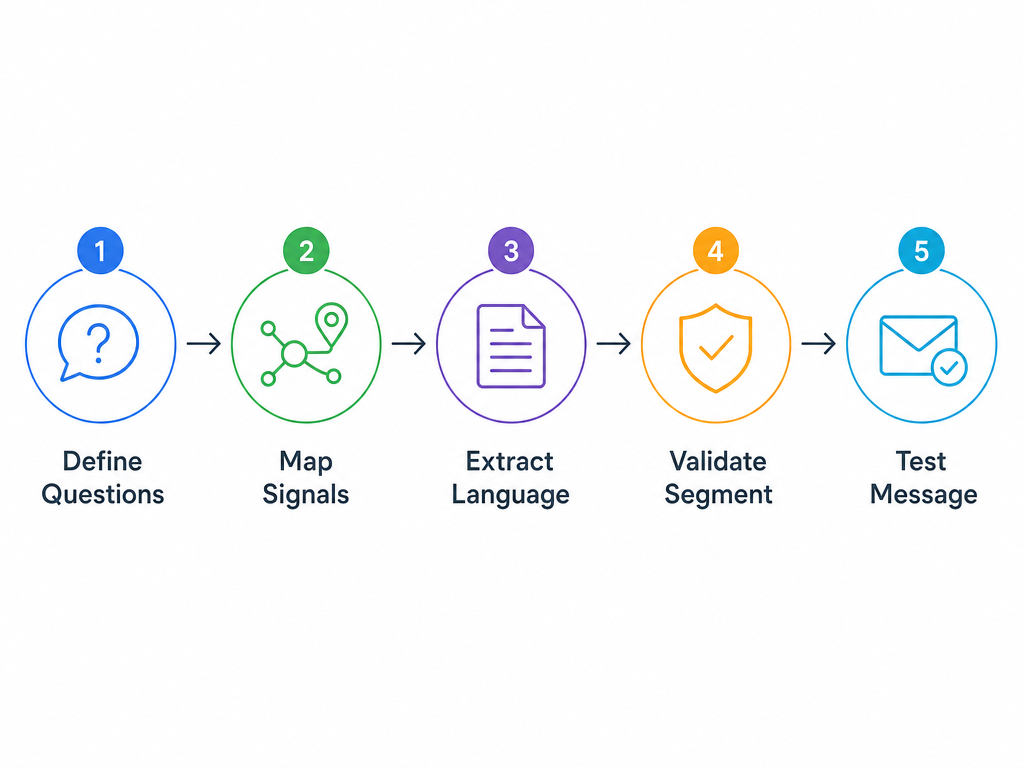
Step 1: Define Your Research Questions Before Picking Methods
The most common mistake is starting with a tool before defining what decision the research needs to inform. Don't open Reddit or fire up a keyword tool until you've answered this: What decision will this research help me make?
Start with three foundational questions:
- Who is the highest-fit segment for this product? — Segment identification
- What language does this audience use to describe the problem? — Message validation
- Is there a behavioral signal that confirms willingness to act? — Pre-conversion validation
If you can't anchor your research to one of these three, you're doing exploration — not validation. Both have value, but they serve different stages.
💡 Tip: Write your three research questions on a doc before you open any tool. Review them after every research session. If your findings don't answer one of the three, deprioritize them.
Step 2: Map Your Signal Sources for Pre-Launch Audience Research
You don't need all signal types. You need the 2–3 that are accessible and directly answer your research questions.
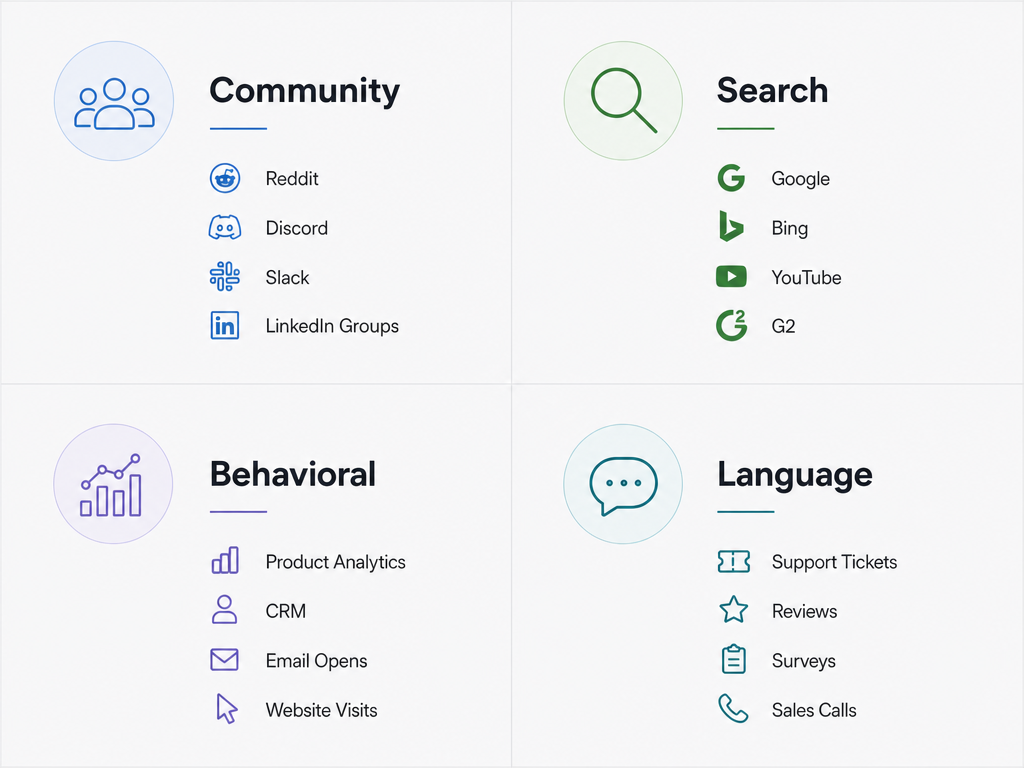
Here's a practical map, organized by signal type:
Community signals
- Reddit threads and subreddit discussions
- Niche forums and brand communities
- Product review platforms (G2, Trustpilot, Capterra)
- App store reviews in adjacent categories
Search signals
- Keyword intent clusters around your problem space
- "People also ask" patterns in Google
- Trending queries in your category (Google Trends, Exploding Topics)
Behavioral signals
- Existing user data, if available
- Beta waitlist conversion patterns
- Content engagement rates by topic and format
Language signals
- Verbatim quotes from community posts
- Support ticket language (yours or competitors')
- Social media comments on competitor content
💡 Tip: Don't try to cover all four signal types in your first research sprint. Pick the two that are most accessible and most directly map to your research questions from Step 1.
Step 3: Extract Audience Language — The Most Underused Step in Target Audience Research
This is the step most growth teams skip. It's also the one that most directly improves conversion. 🎯
Your message should sound like your customer — not like your product team. There's a significant gap between how builders describe products and how buyers describe problems. Closing that gap is what language extraction does.
Here's a repeatable process:
- Identify 5–10 community sources where your target audience is active
- Pull verbatim quotes that describe the problem your product solves
- Tag recurring phrases, emotional triggers, and objection language
- Map extracted language to your current message draft — close the gaps
Product team language vs. audience language — a real contrast:
| Product Team Language | Audience Language |
|---|---|
| "AI-powered audience intelligence platform" | "I need to know if anyone actually wants this before I build it" |
| "Behavioral segmentation engine" | "Who are the people most likely to buy this, and where do they hang out?" |
| "Creative pre-screening" | "I want to test my ad angle before wasting budget on something that won't land" |
The right column is your copywriting brief. Write from there.
💡 Tip: AI-driven tools like Klinko accelerate this process — automating language extraction at scale instead of manually scanning forums for hours. What takes 3–5 days manually can be compressed to a few hours with the right intelligence layer.
Step 4: Validate Your Segment — Not Just Your Idea
Idea validation asks: Does this problem exist?
Segment validation asks: Does this specific group of people have this problem acutely enough to pay?
They're not the same question. A lot of teams answer the first and assume the second. Don't.
Use this three-signal test to validate your segment:
- Size signal — Is the segment large enough to matter for your growth goals? Use search volume, community size, or category data as proxies.
- Urgency signal — Are people actively seeking solutions? Look for high search intent, active community complaints, or strong review volume on existing alternatives.
- Language resonance test — Does your message land with this segment? Test a content piece or landing page headline. Measure engagement rate, not just reach.
💡 Tip: A segment with strong urgency signals and language resonance is worth 10x more than a large segment with weak motivation. Don't chase TAM at the expense of fit.
Step 5: Test One Message Angle Before Scaling
The final pre-launch step is a controlled message test. You don't need a big budget. You need a structured protocol. 🧪
- Write 2–3 message variants using the audience language you extracted in Step 3
- Distribute in a low-cost channel — organic content, a small paid test, or a waitlist email
- Measure click-through intent or sign-up conversion, not impressions
- Pick the winning angle, then scale
Real example: Trinny London, the UK-based beauty brand, tested its brand message in a defined geographic segment before committing to national retail expansion in the US. They ran a six-month pop-up on Prince Street in New York — a controlled, bounded experiment. The result (2025–2026): brand awareness among 25–35-year-olds jumped from 5% to 15% in that segment. Total revenue exceeded $93 million, with retail locations doubling from 21 to 41. What it proves: controlled message testing in a defined segment before scaling is not a slow strategy — it's a confidence strategy. You spend less to learn more, and you scale with data behind you.
💡 Tip: If organic distribution is too slow, a $200–500 paid test on a single channel can give you statistically meaningful signal within a week. Treat it as research spend, not marketing spend.
Pre-Launch Audience Research Methods: A Quick-Reference Comparison
Not sure which method fits your situation? Here's a side-by-side breakdown of the most common audience research methods for growth teams:
| Method | Best For | Time Required | Cost | Key Limitation |
|---|---|---|---|---|
| Community signal scanning | Language extraction, segment discovery | 3–5 days | Low | Qualitative, not statistically significant |
| Search intent analysis | Validating problem size and urgency | 1–2 days | Low–medium | Doesn't capture why people search |
| Beta waitlist + NPS | Validating segment fit and willingness to pay | 1–3 weeks | Low | Requires an existing contact list |
| Paid message testing | Message resonance validation | 1 week+ | Medium | Requires creative asset investment |
| AI audience intelligence | Automated signal scanning + language extraction | Hours | Low–medium | Depth depends on data source coverage |

FAQ
Q: How long should pre-launch audience research take?
A structured pre-launch research process typically takes 1–2 weeks — longer if you're entering a new market, shorter if you have existing user data. With AI-assisted tools, the signal-gathering phase can compress significantly.
Q: What's the most important step in audience research before launch?
Language extraction is consistently the most underused and highest-impact step. Knowing exactly how your audience describes their problem lets you write messages that convert — without expensive A/B testing cycles.
Q: Can you do audience research without a budget?
Yes. Community signal scanning (Reddit, forums, review platforms) and search intent analysis are both low-cost and high-signal. The constraint is time, not money.
Q: How do you know if you've done enough pre-launch research?
When you can confidently answer three questions: Who is the highest-fit segment? What language resonates with them? What signal confirms they'll act? If you can't answer all three, keep going.
Ready to Research Faster? 🚀
Pre-launch audience research isn't a research department luxury — it's a growth team operational standard.
The teams shipping with confidence in 2026 are the ones that validated their segment, extracted their audience's language, and tested their message before scaling. They didn't skip steps. They compressed them.
That's what Klinko is built for. From weeks of manual signal-scanning to hours of structured audience intelligence — niche discovery, language extraction, creative pre-screening — all in one console. So you can make the launch decision with data, not hope.
→ See how Klinko accelerates your pre-launch research process.


